If you’ve ever mixed up KPIs and OKRs, don’t feel bad just yet; it’s a more common mistake than most people realize. Simply put, KPIs measure performance, while OKRs drive progress, and when used together, they turn data into direction. In this article, we’ll break down what makes each framework unique, how they complement each other, and how you can align them to create real, measurable impact across your organization.

What Are KPIs?
Before we delve into OKRs, it’s helpful to start with KPIs, as they’re more widely recognized and easier to understand. Then we lay the groundwork for how both systems connect.
Key Performance Indicators (KPIs) are the measurable metrics that tell you how well your business is performing day-to-day. Think of them as your strategy health check; they show whether operations are stable, improving, or getting sick.
KPIs keep the business grounded; they don’t push you to chase big new goals, but they help teams stay consistent by tracking what already matters. For example, a marketing team might track monthly lead conversions, website traffic, or customer satisfaction scores (CSAT) as KPIs. If conversions start dipping or satisfaction drops, it’s a sign that something’s off.
KPI Example
A KPI for a Sales Department could be:
- Average Lead Response Time.
Below is an example KPI module in Oboard that shows what KPI tracking looks like.

Each KPI must represent only one data point and be easily and unambiguously tracked. Here are some metrics commonly used as KPIs:
- Revenue Growth.
- Market Share.
- Average Lead Response Time.
- Customer Satisfaction Score (CSAT).
- Net Promoter Score (NPS).
- Customer Churn Rate.
What Are OKRs?
Now that we’ve covered KPIs, let’s look at the other half of the equation: OKRs.
Objectives and Key Results (OKRs) combine ambition with measurable outcomes. They help teams set bold goals and track the real progress made toward achieving them.
- Objectives are bold statements that define what we aspire to achieve. They should be ambitious enough to push the boundaries of what seems possible, inspiring teams to reach higher.
- Key Results are the signposts along the way, tracking progress toward these lofty goals. They are specific, time-bound, and measurable, clearly gauging how close we are to realizing our objectives.
OKR Example
Going back to the Sales department, this is what their OKRs may look like:
- [O1] Significantly increase market presence and become a thought leader in the business software solutions sector.
- [KR1] Launch a targeted marketing campaign that results in a 25% increase in website traffic.
- [KR2] Publish 10 high-quality, thought leadership articles on industry trends.
- [KR3] Host a webinar series attended by at least 500 unique participants from the target market.
- [O2] Boost revenue growth by expanding into new markets and acquiring new customers.
- [KR1] Enter 2 new geographic markets, resulting in a 15% increase in global sales.
- [KR2] Acquire 100 new enterprise customers.
- [KR3] Increase cross-selling to existing customers, resulting in a 10% increase in revenue from upsells.
- [O3] Enhance customer satisfaction and loyalty.
- [KR1] Achieve a Customer Satisfaction Score (CSAT) of 8.5 or above.
- [KR2] Reduce customer churn by 5%.
- [KR3] Increase Net Promoter Score (NPS) to 50 or above.
This is way more complex than KPIs, but it serves a similar purpose — defining a target we want to hit. So, what’s the difference?
Below is a clean dashboard view of OKRs within Oboard. It provides a clear view of how your OKRs are performing and where to focus your efforts.

KPIs vs. OKRs: The Core Differences
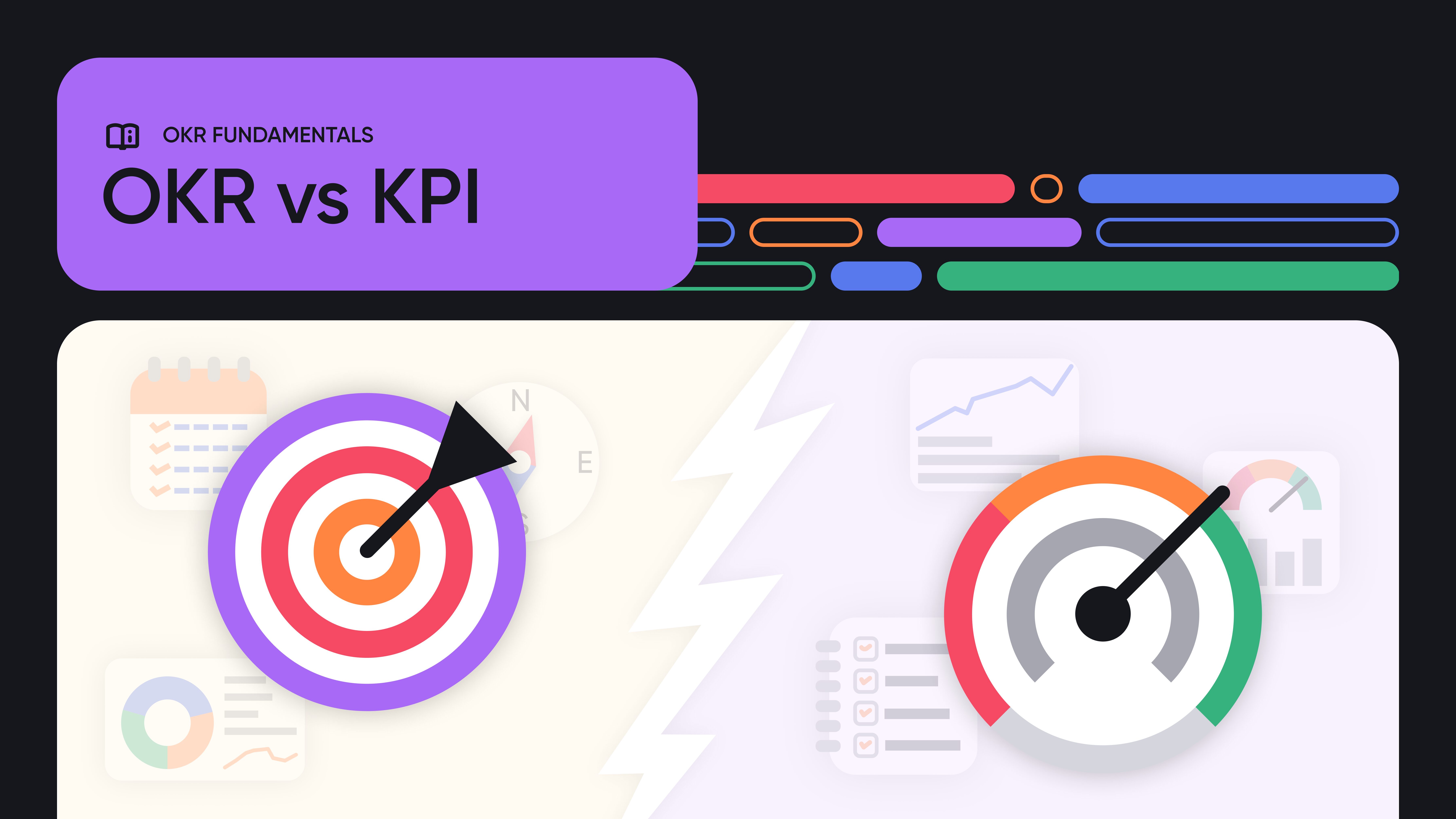
It’s easy to see why KPIs and OKRs are often mentioned in the same breath; both utilize metrics and goals to measure success. But the real difference lies in what they’re designed to do.
- Purpose: KPIs measure stability; they tell you if your business is performing as expected. OKRs, on the other hand, drive change by setting clear targets for improvement or innovation.
- Scope: KPIs are designed to track progress on ongoing activities. They show consistency. OKRs are about driving growth; they focus on moving the needle, not just monitoring it.
- Flexibility: KPIs tend to stay constant over time, giving you long-term benchmarks for performance. OKRs are more adaptable; they evolve in response to changes in strategy, priorities, or challenges.
In short, KPIs are about stability. OKRs are about change. Together, they cover both sides of the performance coin; one keeps you grounded, the other keeps you moving.

Why You Need Both KPIs and OKRs

Our webinar on goal-setting approaches explores how to mix and match different performance frameworks. If you have an hour to spare, check it out—it has a lot of useful information!
KPIs keep you accountable by measuring the health of ongoing performance, while OKRs fuel ambition by setting the direction for meaningful change. Together, they help teams stay both steady and forward-looking.
Take a SaaS company, for instance. Its KPI might be the monthly subscription renewal rate, ensuring consistent revenue. But its OKR could be expanding into two new regions by the end of the quarter, a goal that pushes growth beyond maintenance.
Used side by side, KPIs keep the engine running while OKRs decide where to drive next. And in the next section, we’ll explore how both frameworks work together in practice.

KPIs + OKRs: Better Together in Practice
Imagine a company selling 5,000 subscriptions for their software monthly, yet with much greater ambitions of being an industry leader with hundreds of thousands of subscribers. The 5,000 sales each month is their KPI — the minimum acceptable performance for them, which they know they can achieve. But to represent their ambitions, they must refer to OKRs:
- [O] Dramatically increase subscriptions for our product in Q1
- [KR1] Enter 2 new geographical markets and gain at least 5,000 new subscribers from those markets;
- [KR2] Implement 5 new cross-selling opportunities and/or bundles in existing markets, targeting at least 500 sales from each;
- [KR3] Design a new marketing and sales strategy that showcases our product better and attracts at least 15% more customers from the existing markets.
This combined approach offers several benefits.
Enhanced Transparency
KPIs represent performance metrics, while OKRs showcase the company’s desired change. Together, they provide a more comprehensive picture of the company’s state and ambitions.
Motivation and Engagement
The ambitious goals set through OKRs can motivate teams to push beyond their limits, while the tangible nature of KPIs provides a sense of accomplishment even if those ambitious goals are not (yet) met.
Strategic Alignment and Execution
OKRs help teams maintain a cohesive strategy, while KPIs keep them grounded and discourage risky solutions.
Accountability and Context
KPIs showcase reliable performers, while OKRs provide insight into how innovative and adaptable each individual is. This data can enhance performance reviews and showcase each team member’s contribution to the overall performance.
If you want further information on OKR and KPI methodologies, consider joining our OKR Accelerator program — a comprehensive collection of workshops, webinars, presentations, and other learning resources.
6 Steps to Combine KPIs and OKRs in Practice
If you’re looking to start integrating OKRs and KPIs into your current management structure, here’s how you can do that:
1. Start from Vision, Mission, and Strategy
Every metric and goal should be tied back to the bigger picture, so it’s essential to clarify your company’s purpose and long-term direction before setting any OKR or KPI.
2. Cascade Your Strategy into OKRs
Translate high-level ambitions into actionable objectives and measurable results. OKRs help each team see how their work contributes to the broader strategy.
3. Assess Your Current Performance
Before setting new goals, look at where you stand. You can usually find useful insights from past data. Use existing KPIs to evaluate what’s working and where performance is slipping; that’s your starting point for OKRs.
4. Define KPIs That Matter
Choose KPIs that reflect the health of your operations, keep them consistent across quarters to track stability while OKRs evolve around them.
5. Run Regular Check-Ins and Track Progress with Tools Like Oboard
Schedule quick, recurring check-ins to review both OKRs and KPIs in one view. Oboard makes this easy by combining your objectives, key results, and performance indicators into a single, transparent dashboard.
6. Review, Reflect, and Adjust
At the end of each cycle, look at both your OKR outcomes and KPI trends. Use insights from both to refine your next set of goals and metrics; improvement should never be static unless your anchor metric is a predefined standard.
If you are still unsure where to get started, Oboard offers OKR review consultations and OKR and KPI-based webinars rich with information and real examples to help you get started.
Common Mistakes to Avoid
Even the best frameworks fail when they’re used the wrong way. Here are a few traps most teams fall into:
1. Mixing up KPIs with OKRs.
A KPI tells you how things are going; an OKR defines where you’re headed next. When teams treat KPIs as goals, they stop pushing for real change.
OKRs and KPIs can be converted into one another. Turn OKRs you can hit consistently into maintenance KPIs, and elevate slipping KPIs into OKRs to fix them.
2. Turning OKRs into task lists.
“Launch the campaign,” “Write the report,” “Post on LinkedIn.” Those are tasks, not key results. OKRs should describe measurable outcomes, not activities or Jira tasks.
3. Tracking too many metrics.
If your dashboard looks like a Christmas tree, you’ve gone too far. Focus on the few numbers that move the business. If you need a proper KPI review to fix this, set it.
4. Skipping reviews/check-ins.
Without regular reflection, KPIs lose meaning and OKRs drift off course. Check-ins are extremely important to keep it all flowing together. A rhythm of progress checks will build a work culture that delivers results.
Combine OKRs and KPIs Using Oboard
Integrating OKRs with KPIs can significantly enhance your organization’s strategic planning and execution. However, to do that properly, you need people who understand both frameworks instinctively and can adapt them to your particular use case — and that’s where we come in.

Oboard specializes in blending these frameworks to drive success, offering a streamlined approach tailored to your unique needs. Here’s how we can improve your company’s goal management:
- Customized Strategy Development. We examine your organization’s vision, challenges, and strategic goals. Then, we craft bespoke OKRs and KPIs that strike a balance between ambitious goals and measurable performance indicators.
- Implementation and Support. We provide hands-on support to integrate OKRs and KPIs into your operations. Through comprehensive training sessions, we ensure smooth adoption across all levels of your organization.
- Continuous Optimization. We stay engaged through regular check-ins, monitor progress, and make adjustments as needed. By staying attuned to the pulse, we can identify mistakes and misunderstandings before they become entrenched in the company workflow.
- Building a Culture of Excellence. Oboard embeds the proper goal-setting approach into your organizational ethos by involving everyone.

We commit to your success and ensure that your organization continues to grow and excel, leveraging the full potential of OKRs and KPIs. With Oboard, you’re not merely adopting a framework but embarking on a journey of transformation and excellence!
Want to see what we can do for you? Schedule a demo, and we will walk you through our process while tailoring it to your needs!