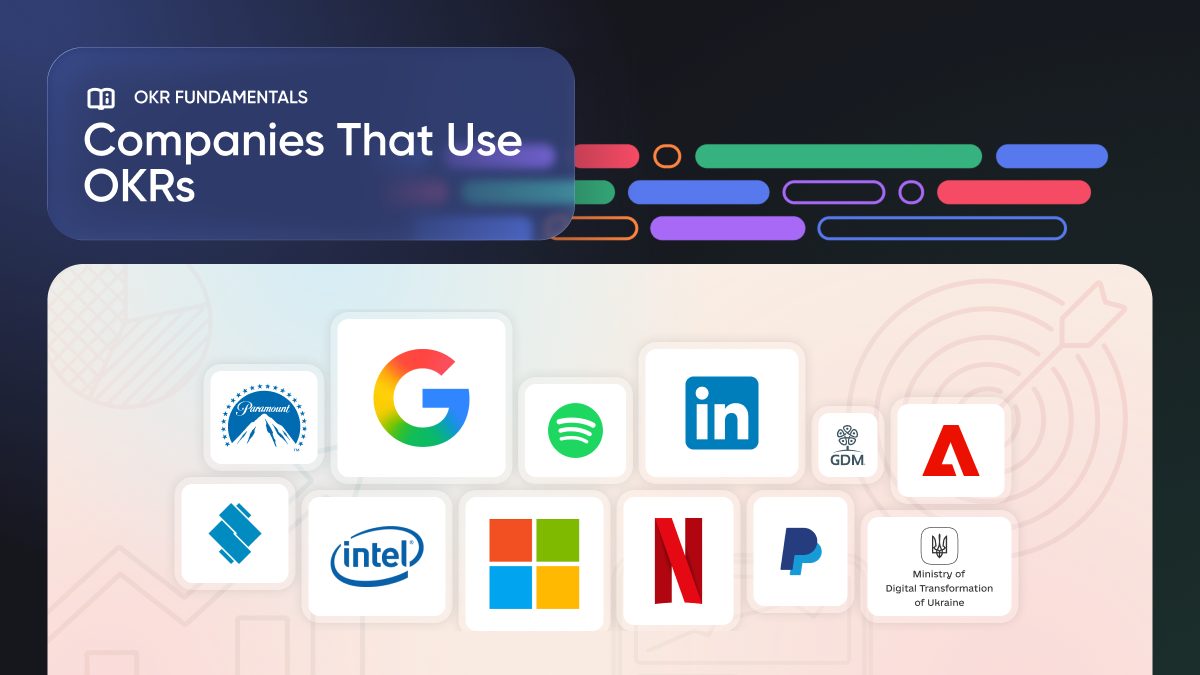
For a long time, companies that use OKRs were closely associated with Silicon Valley. Google helped popularize the framework, Intel helped shape it, and eventually “OKRs” became one of those terms people mostly associated with fast-moving tech companies.
But that’s no longer the case. Today, companies using OKRs include global enterprises, banks, government organizations, SaaS businesses, and operationally complex teams spread across multiple regions. The interesting part is not just who uses OKRs anymore, but why they keep adopting them. In this article, we’ll look at real OKR success stories and how different organizations use the framework in practice.
Tech Companies That Use OKRs
When people ask which companies use OKRs, tech companies are usually the first examples that come up. That makes sense. Fast-moving product teams need a way to keep priorities clear without slowing execution down, especially as organizations grow larger and more distributed.
Google is probably the most well-known company using OKRs today, largely because venture capitalist John Doerr introduced the framework to the company in its early years after learning it at Intel.
What made Google’s adoption particularly influential was the company’s approach to ambitious goal-setting. Teams were encouraged to set aggressive objectives, even if they did not fully achieve every target. Over time, that culture helped make goal-setting more about driving meaningful progress than about having objectives for their own sake.
Google also used OKRs to maintain alignment as the company scaled rapidly. With thousands of employees working across different products and departments, OKRs created a shared structure for prioritization and visibility without forcing every team into the same workflow.
Intel
Before Google popularized OKRs, Intel was already using them internally under Andy Grove’s leadership. In many ways, Intel helped shape the modern OKR framework long before the acronym became mainstream.
One of the most-cited examples is “Operation Crush,” Intel’s campaign to outperform Motorola in the microprocessor market in the early 1980s. The company used a clear, measurable objective tied to specific execution targets, helping to rally teams around a single business outcome rather than disconnected departmental priorities.
That story still gets referenced today because it showed how OKRs could align an entire organization, as large as Intel, around a strategic priority without creating endless layers of reporting.
Other Major Tech Companies Using OKRs
Google and Intel may be the most famous examples, but they are far from the only tech companies who use OKRs today or adopt the OKR philosophy.
- Netflix is widely known for its high-performance, high-accountability culture that emphasizes context over control. While not publicly documented as an OKR-driven organization, it is frequently discussed in relation to alignment and autonomy in fast-moving teams.
- Spotify is known for its “aligned autonomy” model, where squads operate independently while staying coordinated through shared strategic direction. Its approach is often compared to OKR-like systems, though it is not typically described as a formal OKR implementation.
- Adobe is frequently cited in discussions of modern performance management transformations and goal alignment systems, particularly following its shift away from traditional annual performance reviews.
- Microsoft, under its modern leadership, has increasingly emphasized outcome-based execution, cross-functional alignment, and clearer success metrics across teams, reflecting principles that overlap with OKR-style thinking, even if not always branded as such.
The exact implementation differs from company to company, but the pattern is consistent.
If you want to see Google and Intel’s approaches to setting OKRs, we broke them down here, with real-world company OKR examples and guidance on how you can set your own.
Enterprise Companies Using OKRs
As organizations grow, priorities become harder to align across teams, departments, and regions. That’s one of the main reasons enterprise companies use OKRs. The framework helps connect high-level strategy to measurable execution across large distributed teams.
Republic Bank OKR Success Story
Republic Bank is a good example of this in practice. Operating across multiple countries with a large workforce, the organization needed better visibility into strategic priorities and execution across such diverse teams.
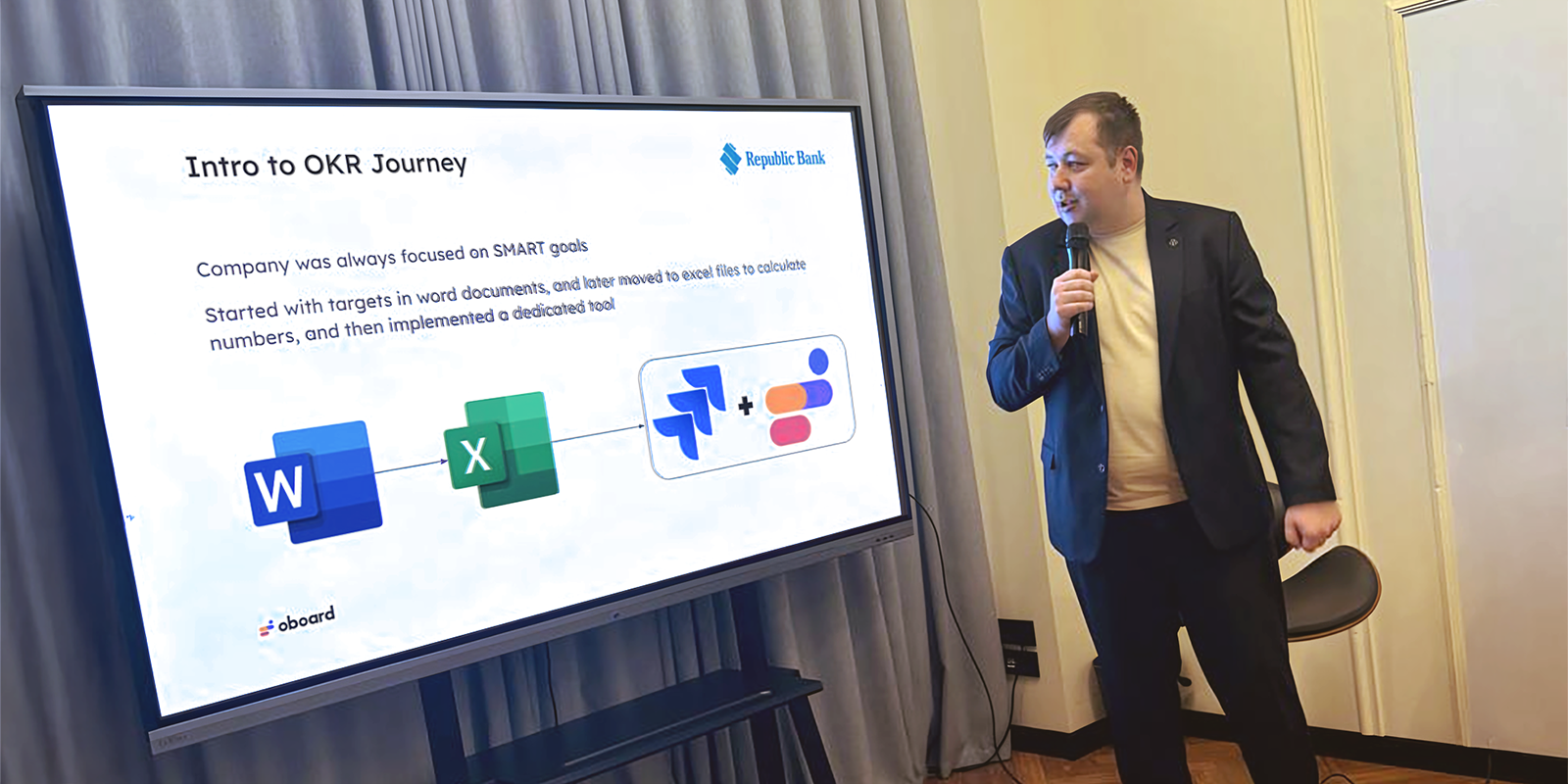
What makes their approach interesting is that OKRs were not treated as a separate management exercise sitting outside daily operations. Instead, they were integrated into existing workflows and operational discussions, making adoption more practical across departments.
A simplified example of how a banking organization might structure an OKR in this context could look like Republic Bank’s:
Objective: Increase active user engagement in mobile banking
Key Results:
- Increase monthly active users by 25%
- Achieve 50% adoption of at least three core features
- Reduce churn rate by 15%
For enterprise organizations like Republic Bank, this level of clarity matters a lot. Leadership teams may define strategic priorities centrally, but execution happens across dozens of operational units. OKRs help bridge that gap by making progress visible and measurable while still remaining easier to track across the business.
Government and Public Sector Organizations Using OKRs
Government organizations are rarely the first examples people think of when discussing OKRs, but large public-sector environments often face the same alignment and execution challenges as enterprises, sometimes at an even bigger scale.
Ministry of Digital Transformation of Ukraine OKR Success Story
One of the more interesting OKR success stories comes from the Ministry of Digital Transformation of Ukraine. The Ministry used OKRs across hundreds of teams and initiatives tied to national digital transformation efforts, including innovation programs, AI adoption, and public digital services.
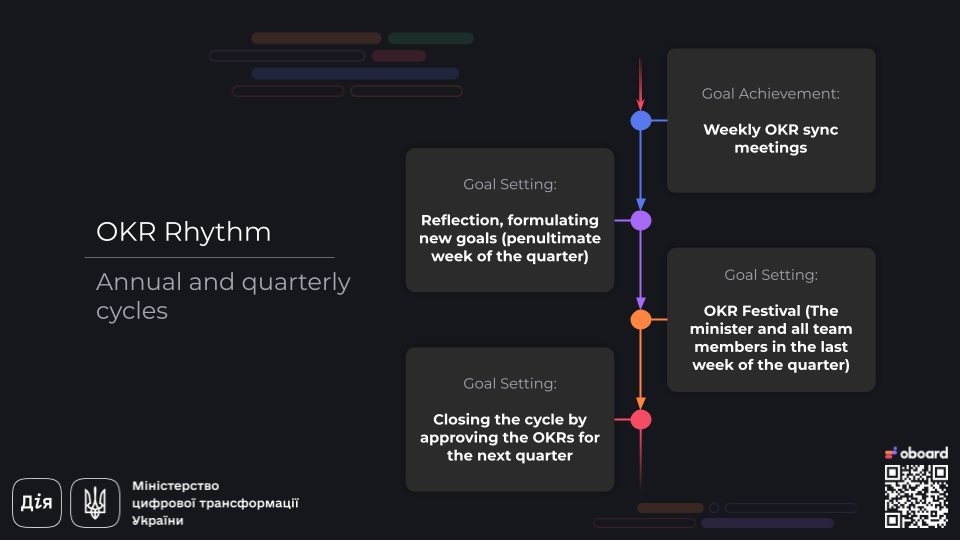
What stood out in their approach was the emphasis on visibility and coordination. With multiple departments working on interconnected national initiatives, OKRs helped create a shared structure for tracking priorities and measuring progress without slowing execution down.
A simplified example of how those OKRs looked:
Objective: Build an effective ecosystem for technology and innovation development
Key Results:
- Implement AI tools across government services
- Expand AI adoption across ministry products
- Improve satisfaction with AI-driven services
One particularly useful takeaway from the Ministry’s OKR journey was the importance of keeping goals visible across teams working on related initiatives. In large coordination-heavy environments, execution problems often come from disconnected priorities rather than a lack of effort.
Their approach showed how OKRs can help maintain alignment even when dozens of teams are moving simultaneously. It’s also a reminder that OKRs are no longer limited to startups or Silicon Valley tech companies. They are increasingly being used in public-sector organizations where coordination, accountability, and measurable execution matter just as much.
Innovation-Driven Companies That Use OKRs
OKRs are often associated with software companies, but many operationally complex businesses use them for a completely different reason: coordination. When teams, regions, and external partners all contribute to execution, visibility becomes difficult very quickly.
GDM OKR Success Story
GDM, a global agricultural genetics company, is one example of this. Operating across multiple regions and working with a large network of external contributors, the company used OKRs to improve alignment between teams, vendors, and strategic priorities.
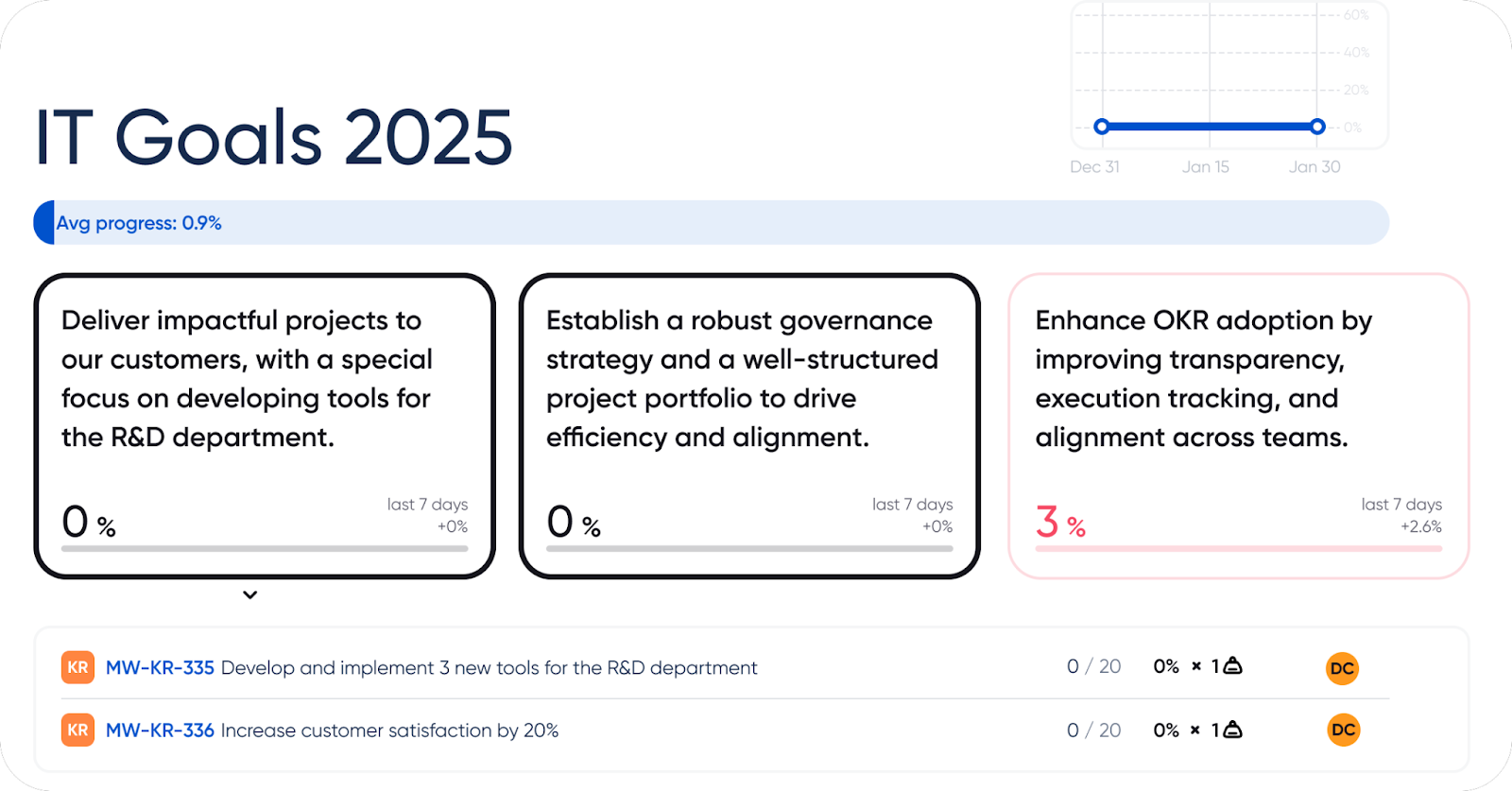
One of the most interesting parts of GDM’s OKR journey was how they extended the process beyond internal teams. The company integrated more than 200 external vendors into its OKR workflows while still maintaining strategic visibility and control across operations. Before automating their OKR process with Oboard OKR Software, they reportedly spent about 260 hours per year manually updating OKR progress.
GDM’s experience is a good reminder that companies using OKRs are no longer limited to SaaS or traditional tech environments. More organizations are adopting the framework to coordinate complex operations, improve visibility, and keep strategy connected to day-to-day execution.
Want to see how other organizations are using OKRs in practice? We’ve documented more real-world OKR journeys from companies across tech, enterprise, government, and operational industries on the Oboard customer stories page.

What Successful Companies That Use OKRs Have in Common
Companies that use OKRs successfully may operate in very different industries, but the patterns behind their execution tend to look surprisingly similar. Most successful OKR implementations we’ve outlined share a few things in common:
- Fewer priorities at a time
Strong OKRs force teams to focus on what matters most instead of spreading attention across dozens of competing initiatives. - Measurable outcomes
The best OKRs make progress visible. Teams know whether they are moving forward because the results are clearly defined and trackable. - Regular check-ins
Companies that get value from OKRs usually review progress consistently instead of treating goals as quarterly documents nobody revisits. - Consistent OKR tracking and visibility
No one on the list is managing their OKRs in a spreadsheet; in the Republic Bank case study, we see how they were able to seamlessly migrate their OKRs from spreadsheets into Oboard OKR software for better visibility on how strategy was being executed and progress tracking. - Clear ownership
Successful OKRs work best when accountability is obvious. Teams know who owns what and where execution may be slowing down. - Alignment between strategy and execution
Many organizations eventually realize that writing OKRs is only one part of the process. The bigger challenge is keeping goals connected to actual execution across departments and operational systems.
That’s one of the reasons OKR tracking becomes increasingly important over time. Without consistent visibility, updates, and tracking, even well-written OKRs can slowly drift away from day-to-day execution. Platforms like Oboard help companies keep strategic goals visible across teams while making check-ins, progress tracking, and alignment easier to manage at scale.

OKR Tracking: The Backbone For Companies that Use OKRs
The bigger the organization gets, the harder it becomes to keep strategy visible across teams. Many companies eventually realize that spreadsheets and scattered reporting systems simply cannot keep up once execution starts involving multiple departments, initiatives, and check-ins.
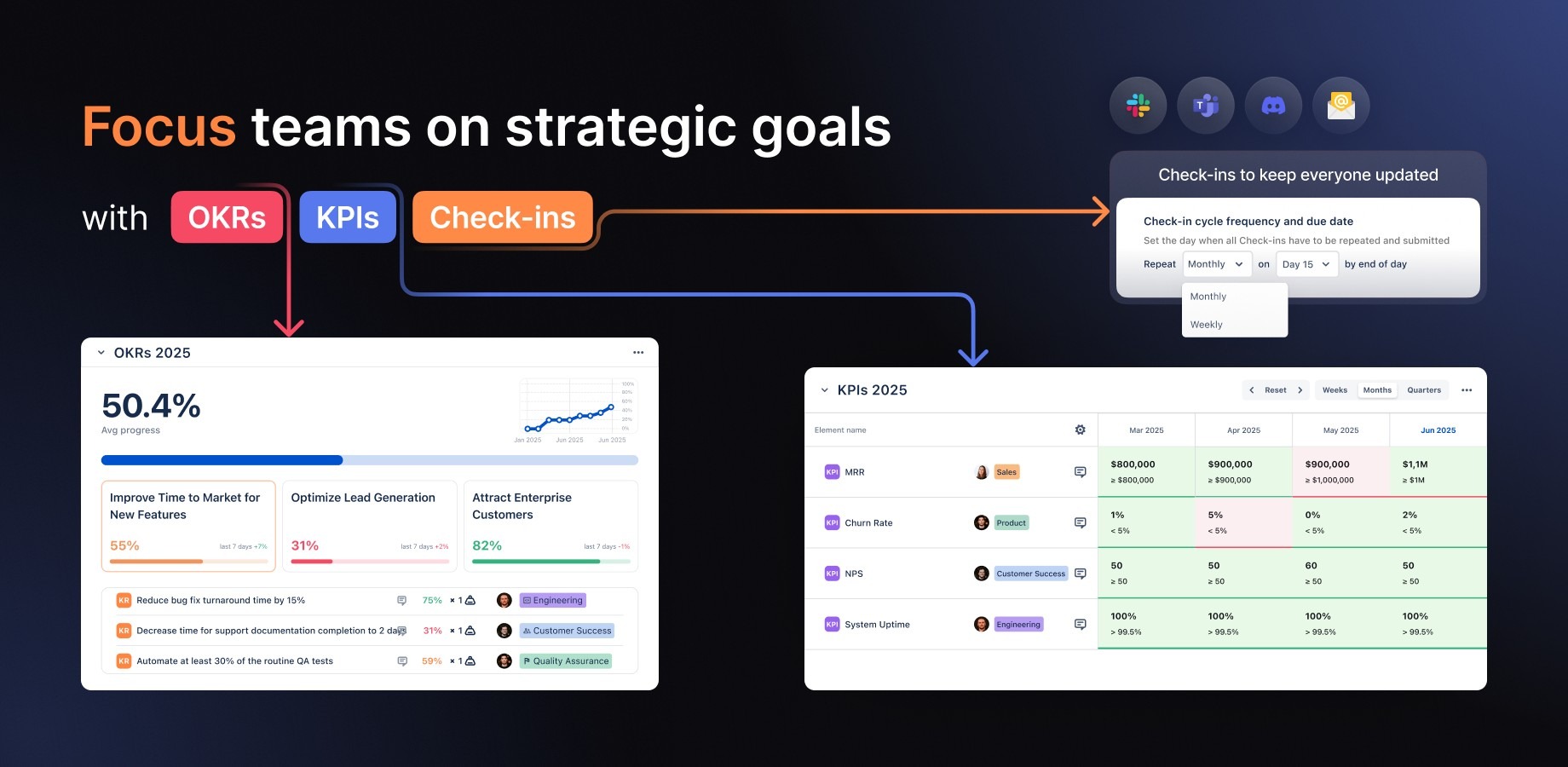
Tools like Oboard solve that by centralizing OKRs, KPIs, progress tracking, ownership, and team visibility in one place. That level of visibility becomes especially important in organizations such as Republic Bank, GDM, and the Ministry of Digital Transformation of Ukraine, where execution depends on multiple teams moving in alignment simultaneously.
Conclusion
The idea that OKRs are only for Silicon Valley startups no longer holds up. Today, companies using OKRs include global tech companies, enterprises, banks, government organizations, and operationally complex businesses managing teams across multiple regions and functions. What connects these organizations is the need for clarity and alignment, as well as measurable execution of complex strategies.

The most successful companies tend to use OKRs to stay focused on fewer priorities, create visibility across teams, while keeping strategy connected to execution rather than letting goals disappear into quarterly planning documents. And as organizations grow, that visibility becomes increasingly important. In practice, strong execution usually depends less on writing ambitious goals and more on ensuring teams can consistently track, update, and align around them over time.