As more organizations adopt the OKR framework, a number of OKR best practices have emerged to help teams get better results. From writing outcome-focused key results to creating a consistent process for reviewing and tracking progress, these practices can make the difference between OKRs that drive execution and OKRs that get forgotten after a planning session.
In this guide, we’ll cover 12 proven OKR best practices that can help your team set better goals and get more value from your overall OKR methodology. But first, let’s take a quick refresher on what OKRs are.

What Are OKRs?
If you’re wondering how to set OKRs, it starts with understanding the relationship between objectives and key results. The OKR meaning is quite simple – Objectives and Key Results – but they build out into a nuanced system that helps organizations turn strategic goals into measurable and executable outcomes.
The more popular perspective for defining Objective is as a destination you want to reach, while Key Results are the metrics that tell you whether you’re getting there. For example, if your objective is to improve customer retention, your key results might include increasing renewal rates from 75% to 85% and reducing customer churn from 8% to 5%. They will usually look like this:
Objective: Improve customer retention
Key Results:
- Reducing customer churn from 8% to 5%
- Increase renewal rates from 75% to 85%
This simple structure is what makes the OKR framework such an effective goal-setting and performance management system. Here are more OKR best practices to help you better set good OKRs.
💡If you’re new to OKRs, it’s important that you don’t confuse the metric side of the framework with KPIs. KPIs are fundamental health metrics that serve as diagnostic indicators of how a business is faring. To better understand the difference between them, you can read this post on OKRs vs KPIs.
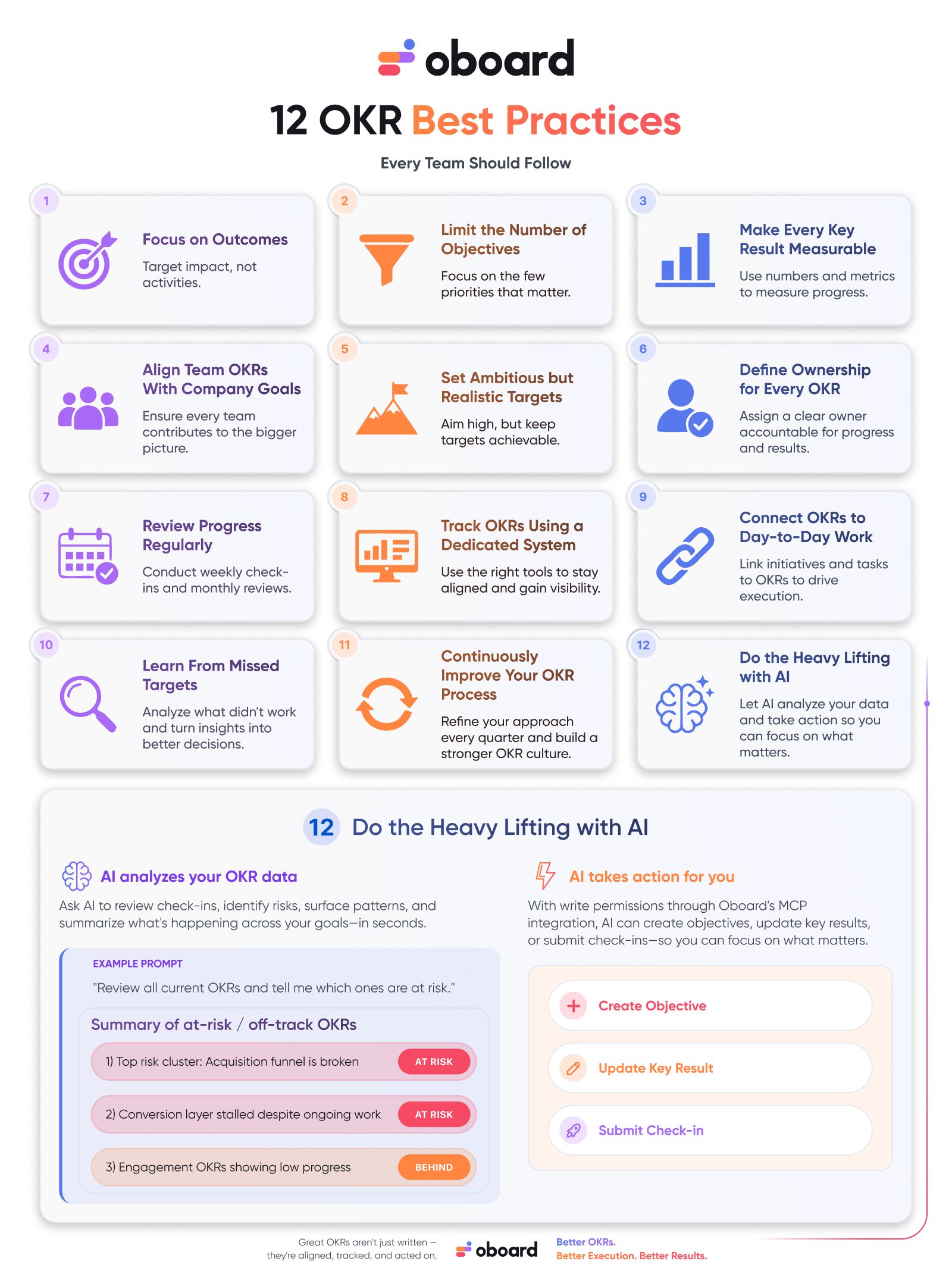
12 OKR Best Practices Every Team Should Follow
Whether you’re learning how to set OKRs for the first time or looking to improve an existing program, these best practices can help your team achieve better results.
1. Focus on Outcomes
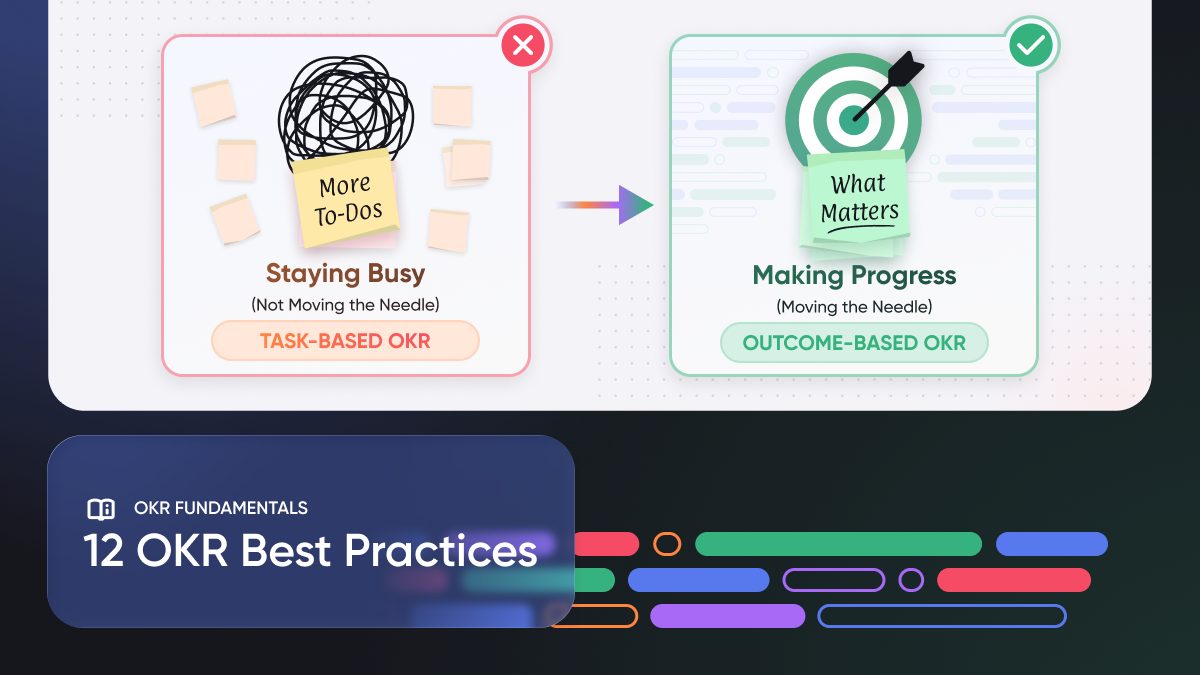
One of the most common mistakes teams make when setting OKRs is confusing activities with outcomes. An objective should describe what you want to achieve, while key results should measure the impact of the work, not the work itself.
For example, you’d like to stay healthy by keeping fit and lean, and it’s important to define this so it’s easy to track. Which of these two Key Results do you think works best?
A.) Run 3km every morning
B.) Lose 5kg in 30 days.
If you chose B, you’re thinking in the right direction. “Lose 5kg in 30 days” is measurable and outcome-focused, making it a much stronger key result than simply running 3km every morning. Running 3km every morning is okay and will probably help you lose some weight, but you wouldn’t be able to track it or compare your progress to see what you might need to adjust and where.
2. Limit the Number of Objectives
For your OKRs, less really is more. A good OKR process helps teams focus on what matters most. That’s difficult to do when too many priorities compete for attention. Many organizations find that three to five objectives per team are a reasonable limit for a quarter. Any more than that, and focus will disappear faster than you can track. Fewer objectives create clearer priorities and reduce the temptation to treat every project as a strategic goal.
3. Make Every Key Result Measurable
A key result without a number is just a good intention. Unfortunately, good intentions don’t drive real results. Effective key results are built around numbers, percentages, ratios, or other clear indicators of progress. For a business context, instead of writing “Improve customer satisfaction,” define what success looks like. Here’s a good example: “Increase customer satisfaction score from 7.8 to 8.5” gives teams a clear target and makes progress easy to evaluate throughout the quarter. When setting OKRs, avoid vague language that leaves room for interpretation.
This is one of the most important principles when setting OKRs. Whenever possible, define key results using metrics that can be tracked consistently throughout the quarter.
4. Align Team OKRs With Company Goals
One of the most important parts of a successful OKR system that you mustn’t skip over is alignment. Team objectives should support broader company priorities, creating a clear connection between day-to-day work and strategic goals. When teams understand how their objectives contribute to company success, prioritization becomes easier. It also improves visibility across the organization and helps prevent teams from working toward competing outcomes.
5. Set Ambitious but Realistic Targets
Ever heard of “stretch goals?” A good OKR methodology encourages teams to aim higher than they normally would. This is why many organizations use stretch goals: targets that push teams outside their comfort zone without becoming unrealistic.
The key is finding the right balance. If targets are too easy, they won’t drive improvement. If they’re impossible, teams can quickly lose motivation. The best OKRs challenge people while still feeling achievable with focused effort and execution. There’s a balance between ambition and possibility that must be found without each one negatively affecting the other.
6. Define Ownership for Every OKR
A strong OKR process requires clear accountability. Every objective should have a designated owner responsible for keeping it up to date, visible, and moving forward. This doesn’t mean they complete all the work themselves. It simply means there’s one person accountable for progress. Without clear ownership, goals can easily become neglected as teams assume someone else is tracking them.
7. Review Progress Regularly
Many teams invest significant time in setting OKRs only to revisit them at the end of the quarter. By then, it’s often too late to course-correct. The most successful organizations track OKRs consistently through weekly check-ins and monthly reviews. Weekly updates help teams identify blockers early, while monthly reviews provide a broader view of performance and priorities. Regular reviews also improve visibility, making OKRs part of everyday decision-making rather than a quarterly exercise.
8. Track OKRs Using a Dedicated System
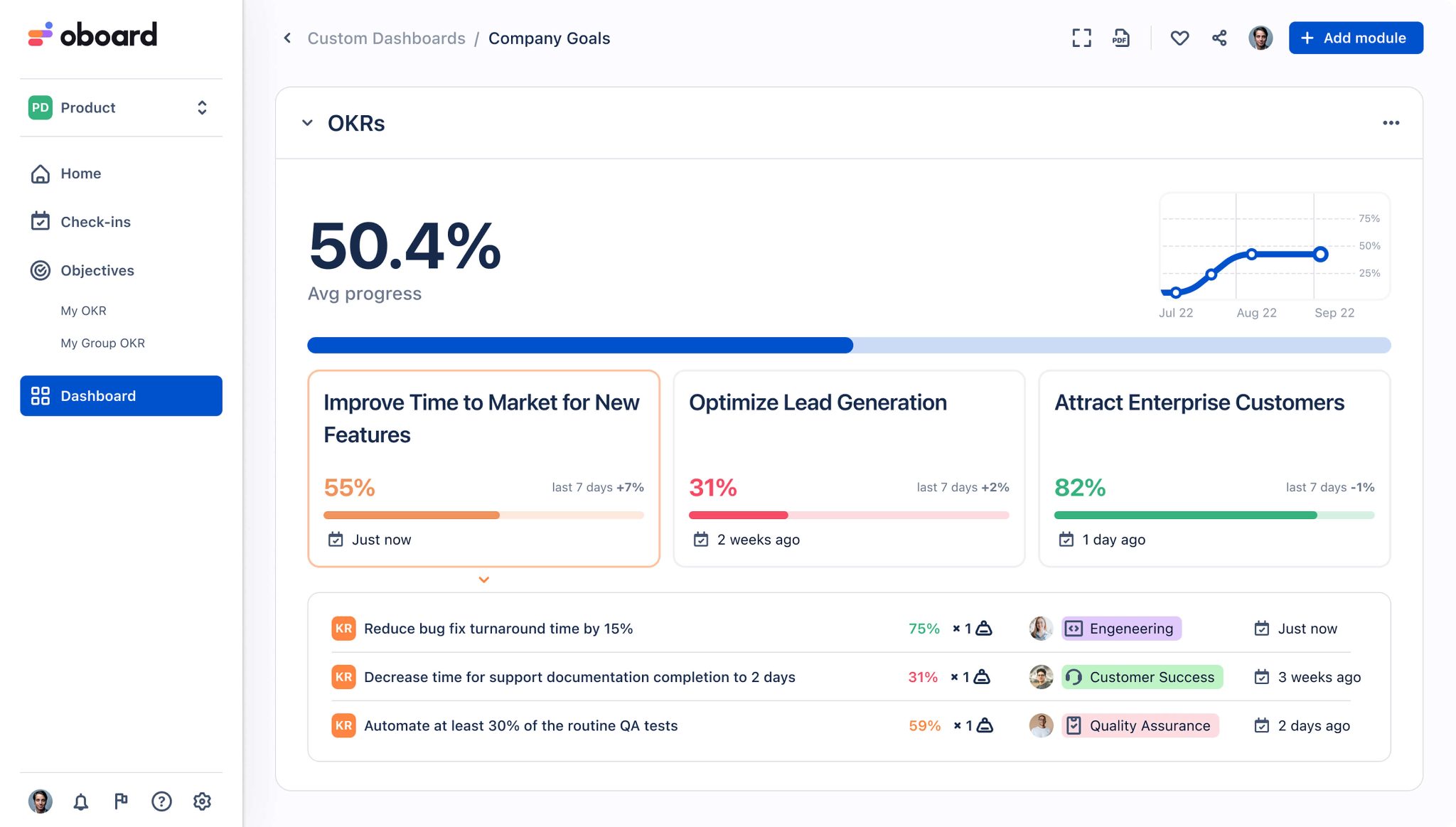
Where do you currently track your goals? In a spreadsheet or a Google Doc? Those are good, but as organizations grow, static documents become increasingly difficult to maintain. A dedicated OKR system like Oboard OKR software makes it easier to track OKRs, monitor progress, and keep everyone aligned around the same objectives. It also integrates with workplace tools such as Jira, enabling teams to connect business strategy to daily execution. Instead of chasing updates across multiple documents, teams gain real-time visibility into performance and can focus more on execution than administration.
9. Connect OKRs to Day-to-Day Work
The OKR framework works best when goals are connected directly to execution. And this is exactly what every business should want – strategy execution. If OKRs live in one document while projects and initiatives live somewhere else, teams can quickly lose sight of how their work contributes to strategic outcomes. Connecting projects, initiatives, and tasks to OKRs creates a stronger link between planning and execution. It also makes it easier to understand which activities are driving progress and which ones may need to be reprioritized.
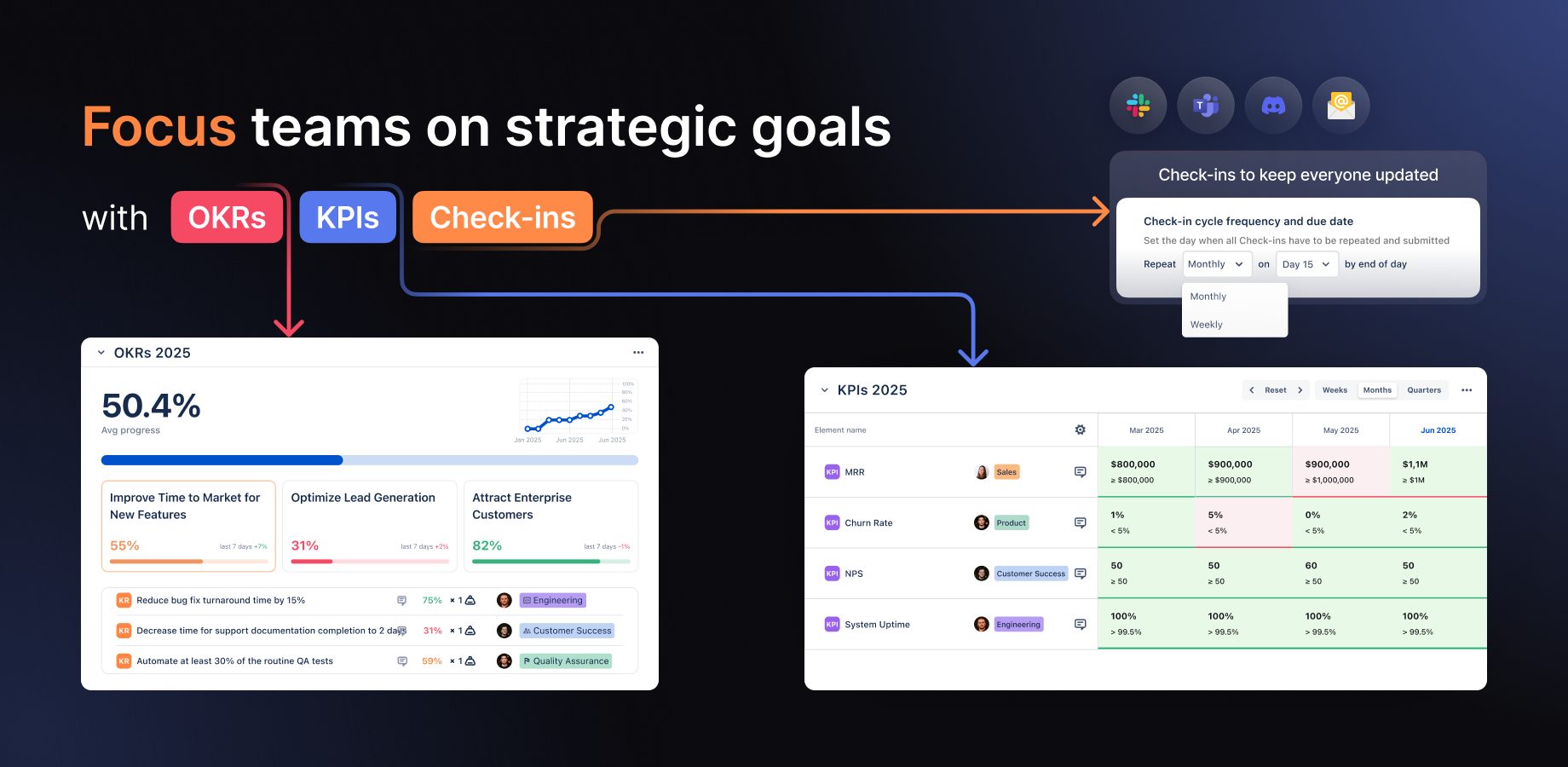
Tooling helps a lot here. OKR setups that track manually will usually be a nightmare to connect to execution. That’s because manual OKR tracking already suggests that there’ll be a gap between your goals and where execution happens. OKR tools like Oboard OKR software for Jira eliminate that gap by providing a system where OKRs tie directly to the day-to-day work that drives them. Organizations that do not use Jira can also take advantage of the standalone Oboard OKR app, where they can create work items that connect with strategic goals.
10. Learn From Missed Targets
Missing a key result doesn’t automatically mean the quarter was unsuccessful. In fact, reviewing missed targets is often one of the most valuable parts of the OKR process. When goals aren’t achieved, take time to examine the assumptions behind them. Were priorities realistic? Did execution fall behind schedule? Were resources available when needed? These insights can help teams create stronger OKRs and make better decisions in future cycles.
11. Continuously Improve Your OKR Process
The most effective OKR methodologies are never treated as finished systems. Teams learn something new during every cycle, whether it’s how they write objectives, measure key results, or review progress.
Many of today’s accepted OKR best practices emerged through years of experimentation and refinement. By continually improving your OKR process, your organization can build a stronger goal-setting culture and derive greater value from the OKR framework over time.
12. Do the heavy lifting with AI
Running OKRs across an entire organization creates a surprising amount of admin work. Check-ins, teams post updates, metrics change, etc. Before long, somebody has to sit down and make sense of it all.
AI is particularly useful here. Instead of reading through dozens of updates manually, you can ask an AI assistant to review recent check-ins, identify patterns, surface risks, and summarize what’s happening across your goals. In a few seconds, you get a clear picture of where progress is happening and where attention is needed.
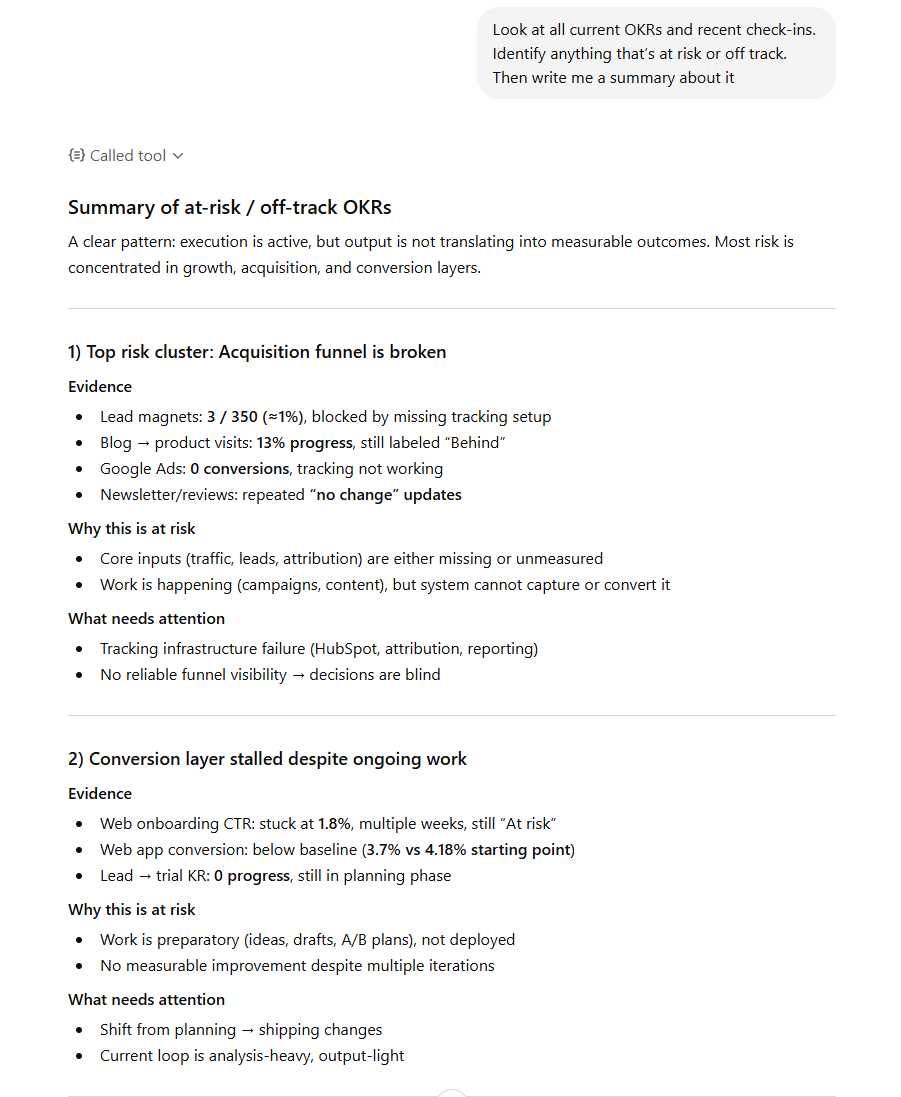
For example, Oboard’s MCP integration allows AI assistants like ChatGPT, Claude, and Gemini to access your OKR data directly. A simple prompt such as “Review all current OKRs and tell me which ones are at risk” can produce a summary that would normally require digging through multiple goals, updates, and reports.
It doesn’t end there. In addition to analyzing your OKR data and offering valuable insights, this MCP integration grants your AI assistant “writer permissions.” This means your AI assistant can also take action on your behalf within Oboard. Need to create a new objective from a strategy document? Update a key result? Submit a check-in? The AI can help you perform those actions instead of simply telling you what to do next.
Common OKR Mistakes to Avoid
Even teams with a solid understanding of the framework can run into problems when setting OKRs. Here are some of the most common mistakes to watch out for:
- Too many objectives: Trying to focus on everything usually results in focusing on nothing. Keep priorities limited and clear.
- Task-based key results: Strong OKR goal setting focuses on outcomes, not activities. Measure results, not effort.
- Infrequent reviews: OKRs should be reviewed regularly, not just at the end of the quarter.
- No tracking system: Relying on spreadsheets and manual updates often results in outdated information and limited visibility.
Avoiding these common mistakes can dramatically improve the effectiveness of your OKR program.

Turning OKRs Into Consistent Execution
Following OKR best practices is important, but successful OKR programs aren’t built during planning sessions. They’re built throughout the quarter. The biggest difference between successful and unsuccessful OKR programs is rarely how goals are written. It’s more often whether teams consistently track OKRs, review progress, and take action when priorities shift or risks emerge.
That’s why many organizations eventually move beyond spreadsheets and disconnected documents to a dedicated OKR system. When goals, progress updates, and reporting all live in one place, teams spend less time chasing information and more time executing their strategy.