If your marketing team generates far more demand than Customer Success can support, it can look like a capacity problem. But it is also an alignment problem. Customer Success should have sufficient notice of a campaign likely to increase demand so the team can prepare. Improving cross-team synergy becomes important in scenarios like this.

Cross-team synergy means teams work well not only within their own departments, but also across them. They understand how their work affects other teams and the wider company goals. This is important because one team can meet its targets while creating problems for another team.
OKRs can help prevent this. They give teams shared outcomes to work toward, make dependencies easier to spot, and create a clear way to track progress across departments. This article explains six practical ways to improve cross-team synergy within your company
What Is Cross-Team Synergy?
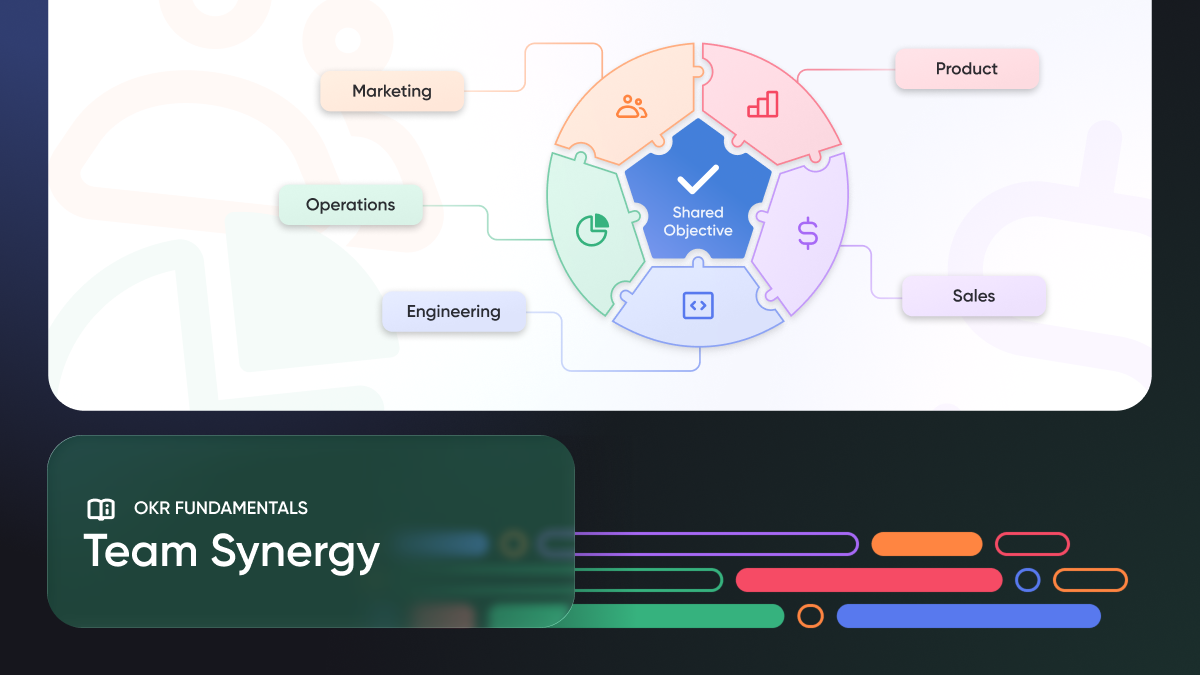
Cross-team synergy happens when two or more teams work toward a shared outcome, and their combined effort produces a better result than they could achieve separately.
We shouldn’t confuse this with basic collaboration. Teams can collaborate by sharing information or working on the same project. Synergy goes further than that. It means each team understands how its work supports the other teams and adjusts as needed to protect the shared goal.
For example, a product launch may involve Product, Engineering, Marketing, Sales, and Customer Success. Each team has different tasks, but the launch only works well when their plans, timelines, and priorities align. Teams can collaborate and still work in silos if their priorities conflict. Cross-team synergy makes that collaboration more effective because teams work toward the same result.
This is why improving cross-team synergy is important. It helps teams avoid working in silos, reduces priority conflicts, and makes it easier to move toward the same business result.
Why Cross-Team Synergy Breaks Down
Cross-team synergy often breaks down when teams focus on their own targets without sufficient visibility into what other teams are doing.
This can show up in a few common ways:
- Teams work toward goals that don’t align with the company’s priorities.
- Dependencies aren’t clear, so one team doesn’t know when another team is waiting on them.
- Progress is tracked across different tools, making it harder to see the full picture.
- Teams discover conflicts too late, after plans or deadlines are already affected.
- Meetings focus on updates instead of the shared outcome.
Improving cross-team synergy means fixing these gaps before they become bigger problems. Teams need a shared view of what matters and how their work connects. OKRs — Objectives and Key Results — can provide that structure.
How OKRs Improve Cross-Team Synergy
OKRs are a goal-setting framework that helps teams move from separate priorities to shared outcomes. It gives everyone a clear view of what the company wants to achieve and how each team contributes to that result.
A good cross-team Objective should be broad enough for several teams to support it, while the Key Results make success measurable.
For example:
Objective: Make onboarding easier for new customers.
Different teams can support this Objective in different ways:
- Product can improve the onboarding flow.
- Engineering can remove technical issues that slow users down.
- Customer Success can improve onboarding completion rates.
- Marketing can set clearer expectations before customers sign up.
The teams are not doing the same work, but they are working toward the same outcome. The value of OKRs in improving team synergy becomes clearer here. They make shared priorities visible, show where teams depend on each other, and give everyone a common way to measure progress. Instead of each department defining success on its own, teams can see how their work supports the wider business goal.
6 Ways to Improve Cross-Team Synergy with OKRs
You don’t improve team synergy by adding another meeting to everyone’s calendar. Teams need clear reasons to work together, clear ownership, and enough visibility to know when their work affects someone else.
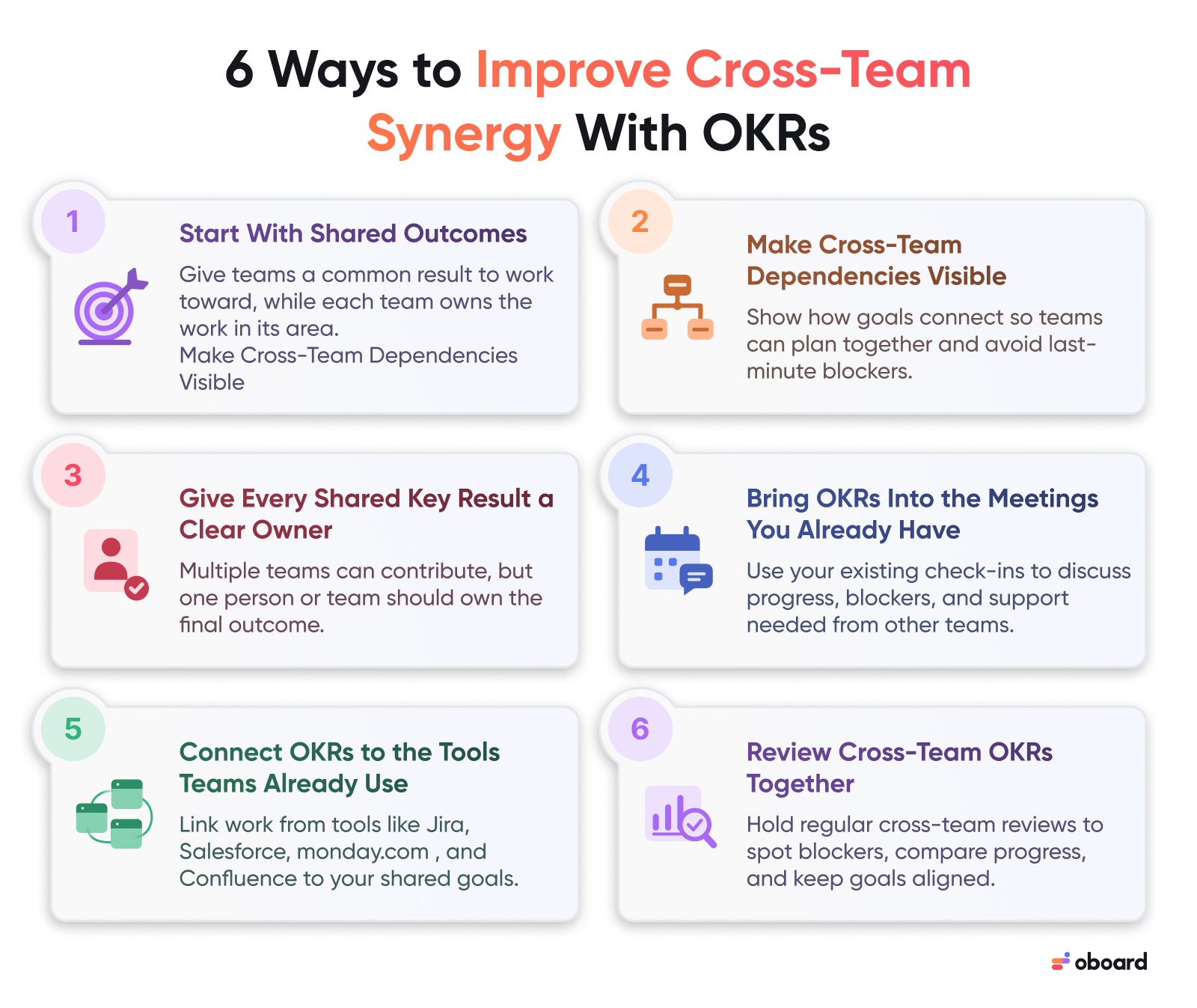
Here are six practical ways OKRs can support improving cross-team synergy.
1. Start With Shared Outcomes
If every department only looks at its own numbers, people will naturally optimize for their own team. That is how Marketing can celebrate a spike in leads while Sales struggles to follow up. Or Product can ship a new feature while Customer Success is not ready to support it.
Shared OKRs help teams look beyond their own targets. A company objective can give several teams one result to support, while each team still owns the work that falls within its area. This is one of the simplest ways to increase team synergy: make sure teams can see the outcome they share before they start planning their individual work.
2. Make Cross-Team Dependencies Visible
Some goals cannot move until another team does its part. For example, Marketing may need a product release before it can launch a campaign. Sales may need new enablement material from Marketing. Customer Success may need Engineering to fix a recurring issue before it can improve onboarding.
If these dependencies are not visible, delays can appear to be performance problems. When teams can see how their OKRs connect, they can plan around each other rather than discovering blockers too late. This is key to leveraging synergy across teams.
3. Give Every Shared Key Result a Clear Owner
Shared work does not mean shared confusion. Several teams may contribute to a Key Result, but one person or team should still own the final outcome. This makes it clear who tracks progress, raises risks, and asks for support when needed.
Clear ownership also helps teams work together without spending time asking, “Who is handling this?”
💡Notes: A Key Result is the measurable outcome used to track progress toward an Objective. For example, if the Objective is to make onboarding easier for new customers, a Key Result could be: Reduce onboarding time from one week to three days. This gives the team a clear measure of whether onboarding is becoming easier.
4. Bring OKRs Into the Meetings You Already Have
OKRs should not become another reporting task. Managers can integrate OKRs into one-on-ones, team check-ins, and weekly meetings by asking simple questions:
- What changed since the last check-in?
- What is blocking progress?
- Do we need support from another team?
- Has any dependency changed?
This keeps goals connected to real work. It also makes improving OKRs part of an ongoing process instead of something teams only think about at the end of a quarter.
5. Connect OKRs to the Tools Teams Already Use
Modern businesses often rely on several tools, especially when different departments have different workflows. Engineering may use Jira. Sales may work in Salesforce. Other teams may use monday.com, Confluence, or other systems for their daily work. The goal is not to force everyone into one workspace but to connect that work back to shared outcomes.
For Agile teams, an OKR Scrum board connection or an OKR software can help link sprint activity and delivery progress to the goals they support. This makes it easier to see whether day-to-day execution is actually moving the company forward.
6. Review Cross-Team OKRs Together
A shared goal needs a shared review.
Cross-team reviews let teams spot blockers, compare progress, and decide where they need support. They also help leaders see when two teams are working toward goals that no longer support each other.
The same principle applies at the leadership level. Bringing OKRs to board meetings can shift the conversation away from lengthy activity reports and toward the outcomes that matter most. Success through synergy becomes easier to see here: teams not only complete their own work but also help each other move the same business priorities forward.
How Do You Know When a Group Has Achieved Synergy?
So, how do you know if all this effort is working? In simple terms, a group has achieved synergy when its combined work produces better results than the teams could achieve on their own. ]One cannot always prove this with one metric, but you can look for signs in both how teams work and what they achieve.
You will usually see it in the way teams work together:
- Dependencies are identified before they become blockers.
- Teams share information without waiting to be asked.
- Handoffs between departments become smoother.
- Conflicting priorities are spotted and resolved earlier.
- Teams understand how their work affects shared company goals.
- Progress improves when teams support each other rather than working in isolation.
You can also see success in the results through synergy. Shared goals move faster, fewer tasks need repeating, and teams spend less time fixing problems caused by poor coordination. To increase team synergy, watch for these signs.
Turning Cross-Team Alignment Into Everyday Execution
As we’ve established, cross-team alignment is useful only when it reaches the work teams do every day. If OKRs sit in one system while projects, tasks, and customer data live somewhere else, teams can lose the connection between strategy and execution. This gap can quickly create misalignment. Oboard helps close it by connecting OKRs with the tools teams already use.
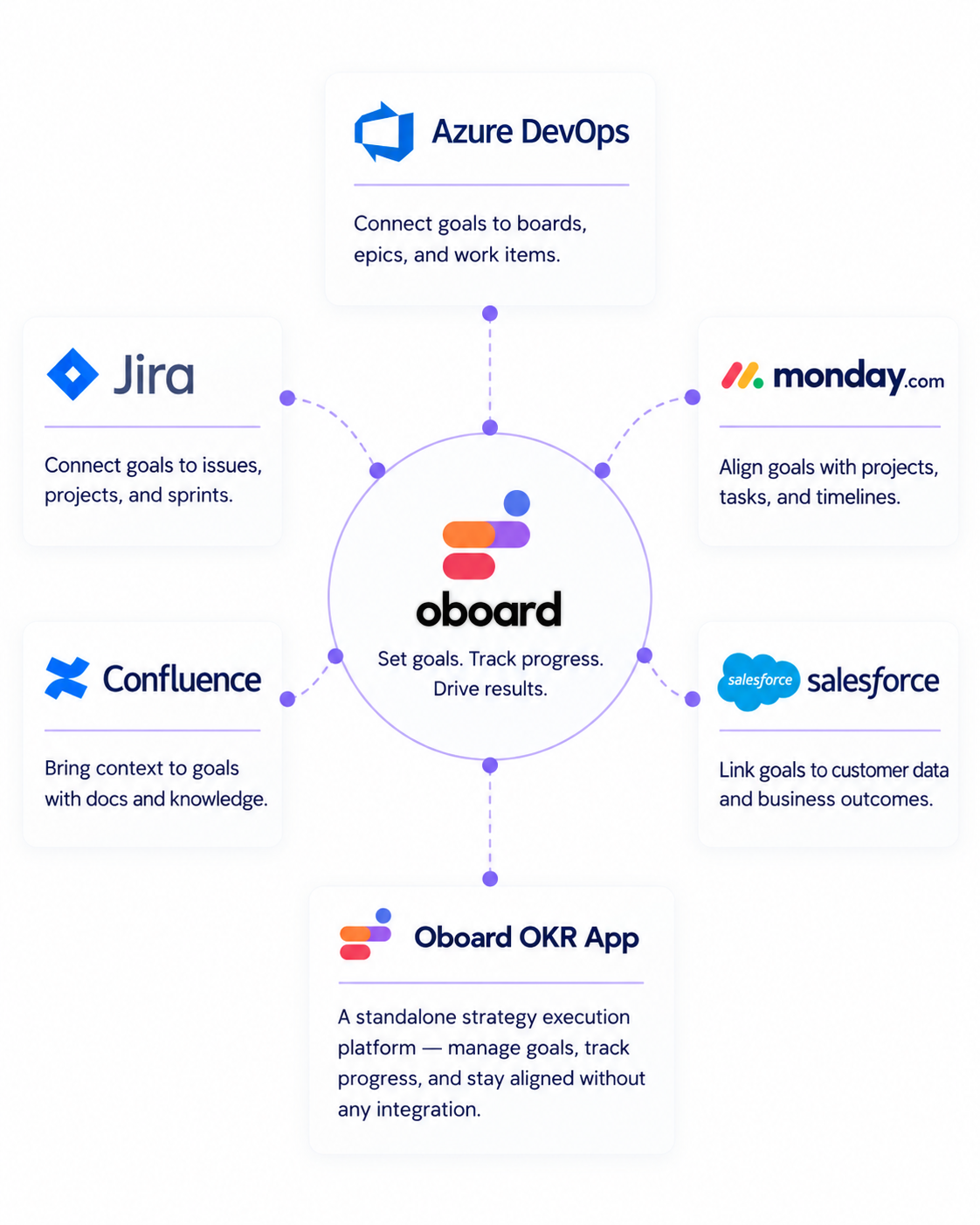
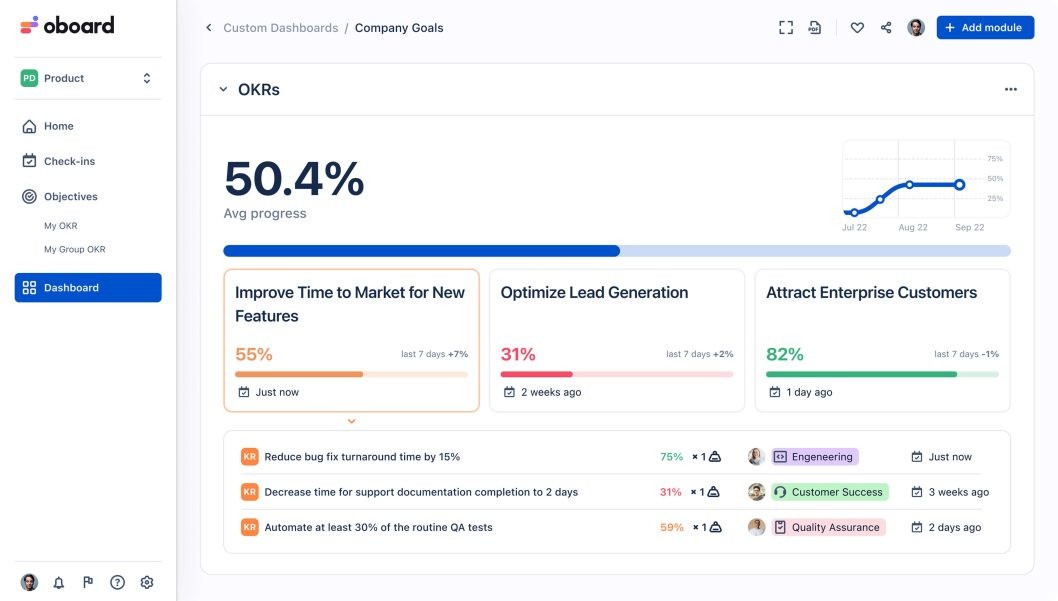
With OKR in Jira by Oboard, teams can manage shared OKRs and even KPIs while still working in workplace tools such as Jira, Microsoft Azure DevOps, Salesforce, monday.com, and Confluence. Oboard can also update OKR progress from connected Jira work items, which reduces the need for manual updates. For companies focused on improving cross-team synergy, this creates one shared view of progress without forcing every department to use the same workflow. Teams can see how their work contributes to wider goals, track dependencies, and check progress across departments.
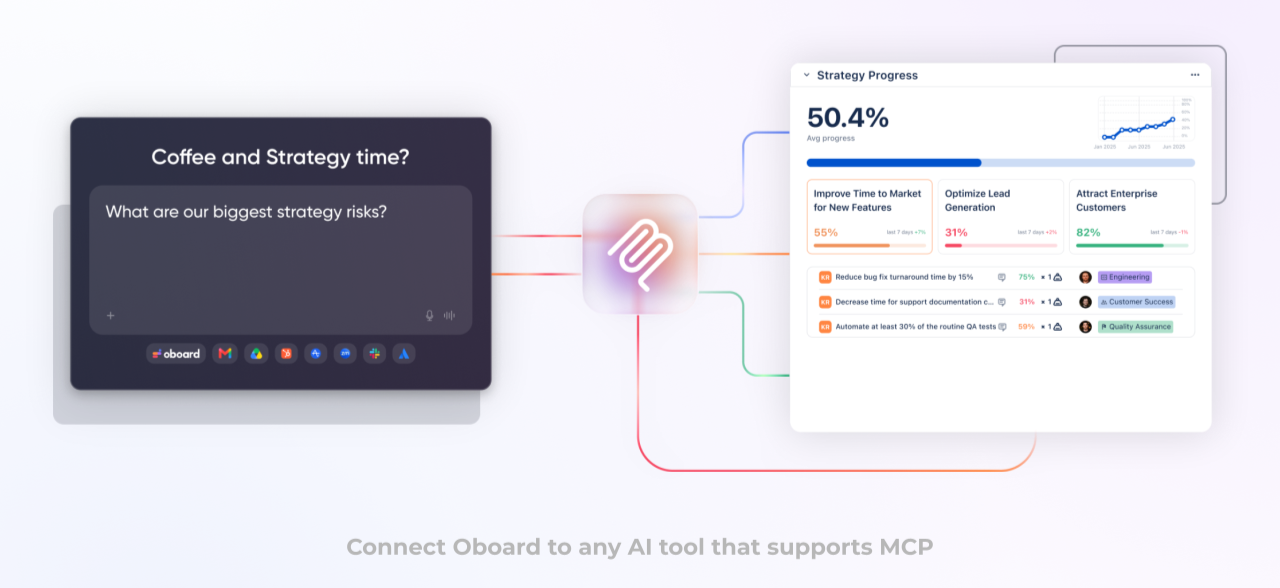
AI can make this process even more efficient. Oboard’s MCP (Model Context Protocol) integration connects AI assistants such as ChatGPT, Gemini, and Claude directly to live OKR data. This lets the AI read objectives, progress, and check-ins instead of making users copy that information into a prompt each time. Teams can ask the AI to find at-risk goals, review alignment, summarize check-ins, or identify blockers across teams.
The connection can also go beyond reading data. With MCP write access enabled, an AI assistant can take actions in Oboard, such as creating an objective, updating a Key Result, or submitting a check-in. This removes another layer of manual work. Instead of finding the right goal, opening it, making the update, and then returning to the AI assistant, users can work with their OKRs directly from the conversation.
This is especially useful for improving OKRs across several teams. Leaders can spend less time collecting updates and preparing reports, while teams get faster access to the information they need to coordinate their work. The aim is simple: keep strategy visible where work happens, and use automation and AI to reduce the admin work that often gets in the way of execution.
Better Synergy Starts With Shared Outcomes
Improving cross-team synergy starts with giving teams something meaningful to align around. They do not need to use the same tools or follow the same workflows, but they do need to understand the outcomes they share, where their work connects, and when other teams depend on them.

OKRs make those connections easier to see. Add integrations and AI, and teams can spend less time chasing updates or moving information between systems and more time acting on what matters. That is what leveraging synergy should look like in practice: different teams doing different work, but moving toward the same result.