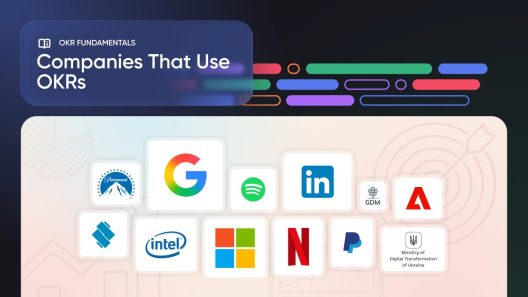
The original OKR method came from Intel and extended to other Silicon Valley representatives. Google adopted OKRs in 1999, during its first year of existence. This method has enabled Google to grow from 40 employees to 60,000 today.
In addition to Google, companies like Intel, LinkedIn, Spotify, Airbnb, and Twitter have already been working according to Objectives and Key Results (OKR acronym) practices. It seems that with this tool any company will develop faster and more efficiently. So what does OKR mean, how to set and use it? Let’s define OKR!
OKR Definition
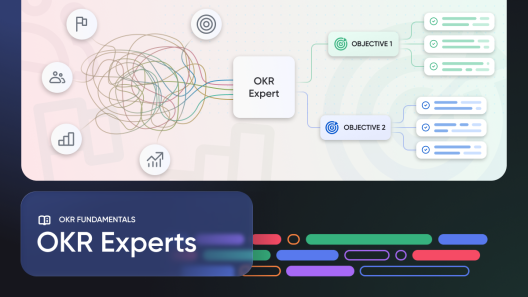
OKR is a goal-setting system that helps build a hierarchy of objectives both for the whole company and for an individual specialist. Objectives are measurable achievements that provide value to the company or customers, and key results are clear signs that the objective has been achieved.
What is an OKR made of?
- The first level is the actual objective that you set for yourself. Choose two or three key aspirations that will lead to the achievement of the company’s goals. It will be perfect if you have one key task. It must be ambitious, achievable, time-limited, and understandable to the entire team.
- The second level is the key results, which are also metrics by which you will measure progress towards the objective.
- The third is the initiatives you need to take for your metrics to start growing.

What is Objective?
It is a goal that will be achieved in the future. The objective sets a clear direction and inspires. The target can be viewed as a destination on the map. The Objective description does NOT contain numbers.
What is Key Result?
It is a metric that has a starting value and a target value to measure progress towards the objective. The key result is like a pointer with a distance that shows how close you are to your goal.
What is Initiative?
It is a description of the work that you will undertake to influence a key result. If the objective is your destination, and the Key Result indicates the distance you need to travel, then the Initiative describes what you will do to get there (get there by car, sail by boat, etc.).
Key OKR questions
Objective:
“Where do I want to go?”
Key Result:
“How do I know whether I get there?”
Initiative:
“What will I do to get there?”
How do OKRs work: On a Example
Objective: This is an unmeasurable goal that should inspire and motivate the whole team.
Example: To turn the website into a lead generation machine.
Key Results: These are not something you do as a process, such as completed projects or launched products. This is exactly the result.
Example: 400 requests from website visitors per month.
Initiatives: These are projects, tasks, or other activities that you think will affect your key results. Initiatives alone do not indicate success – success depends on progress on key metrics.
Example: Create 8 new landing pages.

According to the OKR philosophy, if a company achieves an objective by 100%, it does not unlock its potential, so Google overestimates the objectives twice or three times. The optimal level of objective achievement is 60-70%. By working towards challenging objectives, employees constantly evolve, put effort, and give the company continuous development.
When setting OKRs, it is important to remember that objectives should inspire and motivate; they should pose a problem rather than give a ready-made solution.
As a rule, three key results are identified for each objective. A quantitative indicator is included in the key result statement.
For example:
Objective: Build an affiliate network for the sale of goods
Key Result 1: Develop an affiliate program
Key Result 2: Build 10 automated tunnels to connect partners
Key Result 3: Connect 200 partners to the network
If a key result is difficult or impossible to quantify, you should write a clear, easily measurable result. For example, the key result is “create a prototype of a mobile application.”
At Google, at the end of the quarter, employees measure progress against key results on a scale of 0 to 1. If the cumulative result is 1, it means that the key results were too light. If the cumulative result is 0.4, you need to analyze what is being done wrong. The optimal number of points is 0.6 – 0.7. Employees can use the corporate intranet to monitor how others measure their success in achieving goals, how their work goes with others’ work and the overall picture of Google.
What are the benefits of using OKRs?
Agility
Shorter planning cycles allow for more frequent adjustments, improve responsiveness to change, and drive innovation while reducing risk and unnecessary costs.
Employee engagement
The bottom-up approach of OKRs connects individuals to company goals, increasing their engagement.
Shorter target setting time
The simplicity of OKRs speeds up and simplifies the goal-setting process, significantly reducing the time and resources required.
Ambitious goals
Separating OKRs from rewards and using extensible goals allows teams to set ambitious goals.
Independence and responsibility
Teams receive clear direction and are free to choose what to do to achieve their OKRs. They take responsibility for their goals, with clear criteria for success known throughout the company, which engenders mutual commitment.
Transparent communications
With transparency and simplicity, teams gain a better understanding of the company’s goals and priorities as a whole and the contribution that each member can make.
Alignment and cross-functional interaction
The simplicity of OKRs speeds up and simplifies the goal-setting process, significantly reducing the time and resources required.
Focus and discipline
Having a small number of goals allows the company to keep the focus on selected initiatives and direct efforts in a more targeted manner.
What to start from
Setting OKRs is an open process. It takes place with the participation of all employees at the stage of submitting proposals. The methodology provides for three directions of communication:
- Top-down: The objectives formulated for the company as a whole apply to the OKRs of its departments, teams, and employees.
- Side-by-side: Individual departments work together to set shared OKRs, in addition to supporting the company’s global OKRs. For example, development and support can launch a joint initiative to reduce bugs.
- Bottom-up: A specific good idea can grow into OKRs for a team, department, or even the entire business. This is how Gmail came about, starting as a personal project of a Google employee. If we understand that we can do something good, useful, and valuable, this idea can be scaled and implemented. If we have found a gold mine – let’s develop it.

OKR building is a two-way process, and it is expected that half of the company’s objectives will be formulated in the top-down direction and the other half in the opposite bottom-up direction. In OKRs, it is important to achieve a common understanding of the most important goals. Realizing that a specific idea is still not as important as another makes it easier to refuse to implement it and focus on the essential things.
Every department is not expected to support all global initiatives. Departments are specialized, and this limits their ability to support all business objectives. For example, if the global goal is “to reduce production cost by 10%,” the marketing department cannot help that much.
In addition to supporting overall business objectives, departments or teams can and should set local objectives. This is necessary because, at every level, there is potential for improvement. If you focus only on the business’s global objectives, then over time, such a bias leads to dysfunction due to accumulated problems.
OKR Tools
At the level of the mobile development department, this Objective and Key Results may correspond to:
Increase user satisfaction by 30%.
Here are also some useful OKR tools that may come in handy:
How to set objectives
Formulating OKRs is difficult but possible. To do this, you must adhere to the following principles:
- The objective should be ambitious. Achieving it must seem difficult, to the point of being a challenge. However, the objective should be potentially achievable while remaining ambitious.
- An ambitious objective motivates you to achieve better results. People tend to play it safe and set simple objectives for themselves, but they may not be achieved in this case. A challenging objective requires persistence and ingenuity. Even if this objective is not fully achieved, the result will be much higher than conservative expectations.
- The number of objectives should be between 3 and 5. This is important for two reasons. First, more objectives tend to burn efforts. Second, OKRs are a global initiative and require communication and coordination. It is possible to form and fulfill joint objectives among a dozen departments if each department has no more than five of them. If each department tries to work on a dozen objectives, it will take all the time just to figure out who is planning what to do.
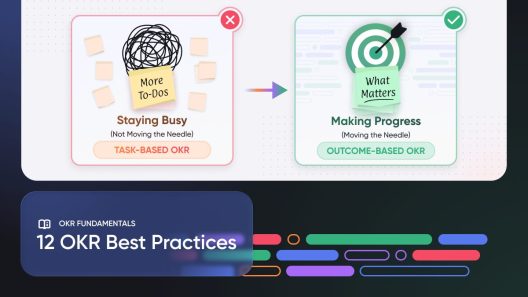
- Objectives should lead to new achievements. It makes no sense to set an objective to keep doing the same: hire only the best employees, maintain a service uptime of 99.9%, or develop new features. These are all important things, but they should be done without being reminded. OKRs are not meant to maintain the status quo.
- The objective should define the end state. Where we want to go, what to get, what to achieve. Vague phrases like “improve,” “simplify,” “facilitate” only confuse. Articulating an endpoint allows you to focus on achieving it and create a concrete plan to achieve it.
- Launch a product for a segment of the Z market.
- Increase geographic coverage of Uber drivers.
- Increase average watch time per user on YouTube, etc.
- A common mistake when formulating the objective is determining the direction of travel instead of the end position.
- The objectives should be clearly stated. All observers should equally well understand the objectives and the fact of their achievement.
- Unclear or ambiguous objectives can lead to inconsistencies or conflicts.
How to set Key Results
- The key result must be easily measurable:
- The loading time of the main page on the websiteto be reduced from 3.1 to 1.2 seconds.
- Feature X to be released before August 1.
- Order processing time to be decreased from 12 to 6 minutes.
- Each objective should be measured against approximately 3 key results. A large number of results, as well as goals, lead to defocusing. On the other hand, a single outcome actually replaces the objective.
- Achievement of the result should directly lead to the achievement of the objective. A result that indirectly affects the achievement of the objective may lead to the fact that it will not be useful or impose the choice of the wrong decision.
- The key result is the result, not the way to achieve it. The freedom to choose the way to achieve the result is the essence of OKR; it gives the performer a place to maneuver in choosing the most suitable solution.
- Achievement of the key result must be confirmed. If it is impossible to determine that the result has been achieved in practice, the definition of such a key result is meaningless.
Conclusion
Any growing company needs to have a clear understanding of the long- and medium-term goals. The team needs to understand the final look of the product so as not to lose motivation. The implementation of OKRs will allow you to understand the company’s goals, formulate them together with the team, adjust the path, focus on the important, motivate employees and unite their efforts.
Of course, any tool must be adapted to the company’s specifics and needs, be flexible, and ready to change. OKR will not solve all the organization’s problems, but it will make it more efficient and transparent.