You’ve probably heard the buzz around OKRs. The acronym stands for Objectives and Key Results, a goal-setting and strategy execution framework that’s become the darling of the startup world and big corporations. With endorsers like Google, Spotify, and LinkedIn, OKRs have proven their value across many industries.
There are many guides to OKRs. For example, if you are interested in the history and theory of OKRs, we highly recommend John Doerr’s OKR guide. This article will focus on the more practical skill of writing OKRs that will positively impact your company.

The OKR Formula
At their absolute basic, you can formulate OKRs as a simple expression:
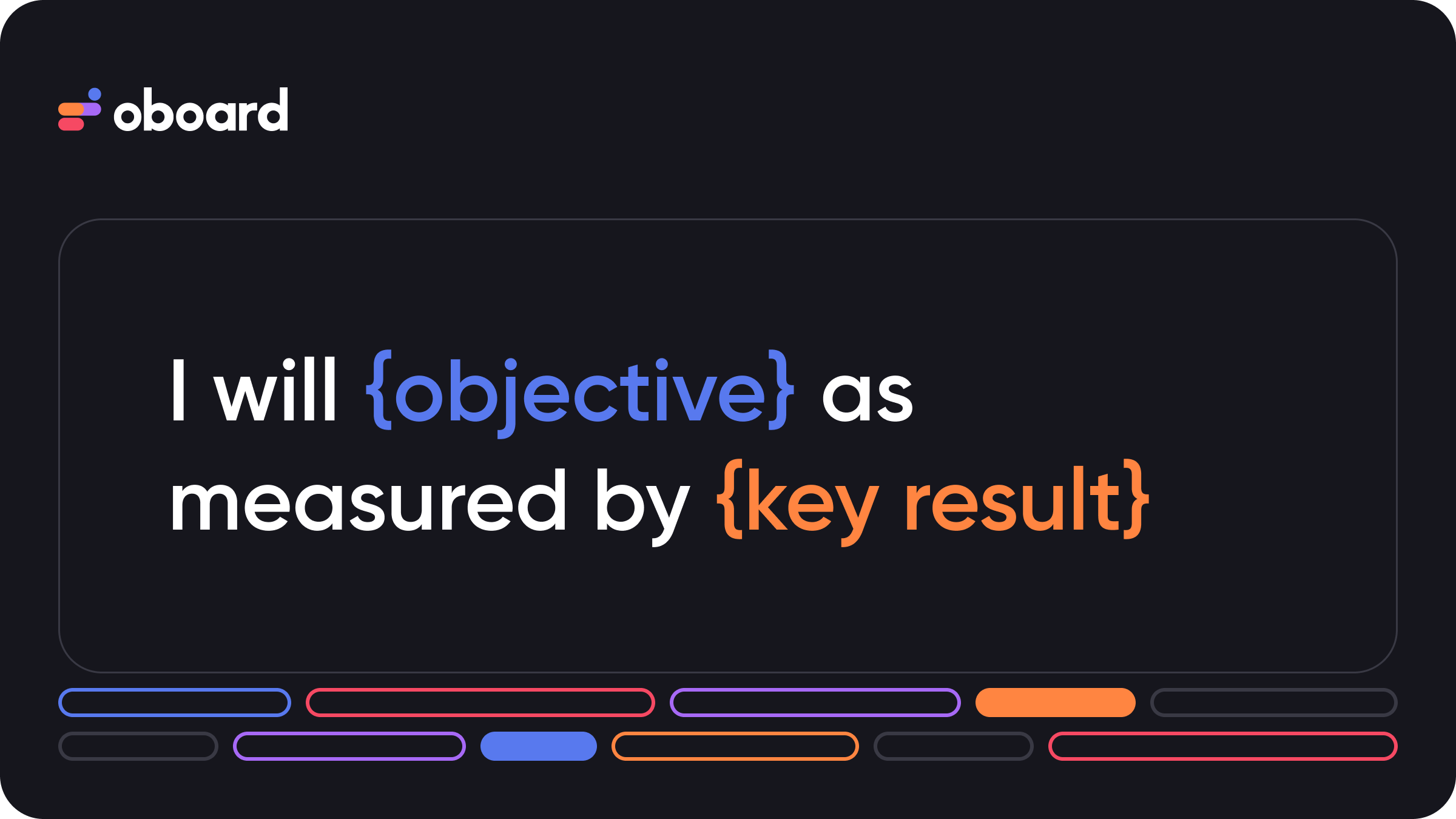
An Objective is a big, ambitious goal that you want to achieve. It should come from your project’s Vision and Mission statement and represent the goal of your work for the next OKR period. If you are familiar with Scrum, think of Objectives as your Sprint Goals — only the Sprint is three months long.
Key Result is a metric used to measure your progress toward achieving the Objective. While Objectives can be abstract, Key Results should always be represented by hard numbers — a.k.a. be measurable.
With that OKR format, you can formulate a simple OKR. For example:

Now you know how to create OKR. However, these OKRs are basic and can only be used to showcase the system. If you want to write OKRs that will drive your company to greatness, you need context.
How to Set Objectives in the OKR Framework
If you go back to the Objective description — scroll a few paragraphs up — you will find that they represent ambitious goals. Ambition is important because it is one of the critical aspects of OKRs.
There is a common misconception that OKRs represent expected performance. They do not — that’s the job for KPIs, which are much better suited to the task and can be used alongside OKRs. We’ve got an article on that if you are interested.
Instead, OKRs represent a desired change. When you write OKRs for yourself, your team, or your company, you must ask yourself a question. The question is, “What do I want to change so much that I am willing to spend the next month/quarter/year working towards it?” And the way you answer this question entirely depends on the context.
How to write OKRs that Account for Context
The best way to showcase the importance of context is with an example. Samsung Mobile Division (MX) makes customer electronics and earns about 19 billion USD in revenue annually. In recent years, they have also pushed to move all their phones to in-house CPUs rather than purchasing Qualcomm and Mediatek solutions.
With that in mind, which of these Objectives would better fit them?
- [O] Make 18 billion USD in revenue
- [O] Pivot the mobile division towards in-house solutions.
The first Objective on that list is already achievable, expected, and almost guaranteed to happen. The company may not change at all and still achieve it. It undoubtedly matters — and would make a great KPI — but it is not suited well to OKRs.
The second Objective works. The change is stated directly — the company doesn’t use cheaper CPUs when it should. It is an ambitious goal, and by trying to achieve it, the employees will change the company: improve the current products, optimize the software, etc.
However, imagine if Samsung MX was already using their in-house CPUs but was struggling to sell their phones, bringing less than 1 billion USD in revenue. In that case, our context would be reversed. Using their CPUs would be expected, while launching the company into a new revenue bracket would be an ambitious goal that would radically change it.
You need context to write OKRs that suit your company and situation. Without it, you will never know what to change and why. But even the most context-aware and practical Objective still needs proper Key Results.
How to Write SMART Key Results
If the Objective is your guiding star, the Key Results represent your route to getting there. They are just as crucial as the Objective itself. After all, if you mismeasure your progress, you might never achieve your goals.
There are many ways to set Key Results. While most of them should directly contribute to your Objective, some might exclusively support others or make them possible in the first place. Check out our OKR Alignment and Breakdown Guide to learn all about that.
However, there is one universal requirement for all KRs — and that is SMART.
What are SMART Key Results
SMART is a goal-setting framework that has been around almost as long as OKRs — it was first introduced in 1981 by George Doran, Arthur Miller, and James Cunningham. Compared to OKRs, it is rather primitive and doesn’t go particularly in-depth, but we can enhance our Key Results with it.
SMART is an acronym for Specific, Measurable, Achievable, Relevant, and Time-bound. Here is how those qualities apply to Key Results.
- Specific. Key Results should be evident and grounded.
- Measurable. Key Results should be quantifiable.
- Achievable. Key Results should be in the realm of plausibility.
- Relevant. Key Results should contribute to the Objective in some way.
- Time-bound. Key Results should have a deadline.
Designing SMART Key Results ensures that your OKRs are practical, reasonable, and beneficial to the company.
SMART Key Results Example
Let’s go back to Samsung MX. If you remember, the Objective we’ve settled on was using in-house CPUs more than the competitors’ offerings. Let’s develop sample OKRs around this Objective while following the SMART framework.
- [O] Pivot the mobile division towards using in-house CPUs
- [KR] Integrate Samsung Exynos into 20% of budget mobile phones released within 6 months.
- [KR] Reduce heat output of top-end Exynos CPUs by 15% in 9 Months
- [KR] Achieve cost-saving of at least 20% per unit over Qualcomm and Mediatek solutions.
All of them are SMART and contribute towards achieving the Objective directly or indirectly. Let’s take the first one and break it down to see just how SMART it is:
- Specific. The goal is to specifically focus on integrating an in-house CPU into a budget mobile model.
- Measurable. The goal of a 20% integration is quantifiable, providing a clear target to aim for.
- Achievable. Assuming adequate development and manufacturing capabilities, integrating the CPU into a budget model within six months is doable.
- Relevant. Directly supports the Objective of replacing third-party parts with own designs.
- Time-bound. “Within six months” sets a clear time frame for achieving this Result.
If you want to succeed with OKRs, SMART is not negotiable. Only with them can a team efficiently achieve its Objective.
Conclusion
Understanding and implementing OKRs effectively can be a game-changer for any organization. While this article explains how to write OKRs effectively, applying these concepts in real-world scenarios can sometimes be challenging. Ambiguities can arise, teams can be misaligned, and even well-set OKRs can fail to bring about the desired change.
That’s where Oboard OKR Consulting and Coaching come into play. Our experts specialize in helping you tailor OKRs to your specific organizational needs, align them across various departments, and ensure that they are SMART from the get-go. We also provide ongoing support to ensure that your OKRs are agile, adjusting them as your company evolves and faces new challenges.
From small startups to industry giants like Samsung, companies of all sizes can benefit from professional guidance in OKR setting and strategy execution. Don’t leave your goals to chance; ensure they are SMART, aligned, context-aware, and poised for success. Your ambitious objectives deserve nothing less.