Republic Bank is one of the leading banks in the Caribbean, managing over $16 billion USD in assets. Operating across 15 territories, it serves customers through 125+ branches and 350+ ATMs, specializing in retail, corporate, and investment banking.
The Challenges
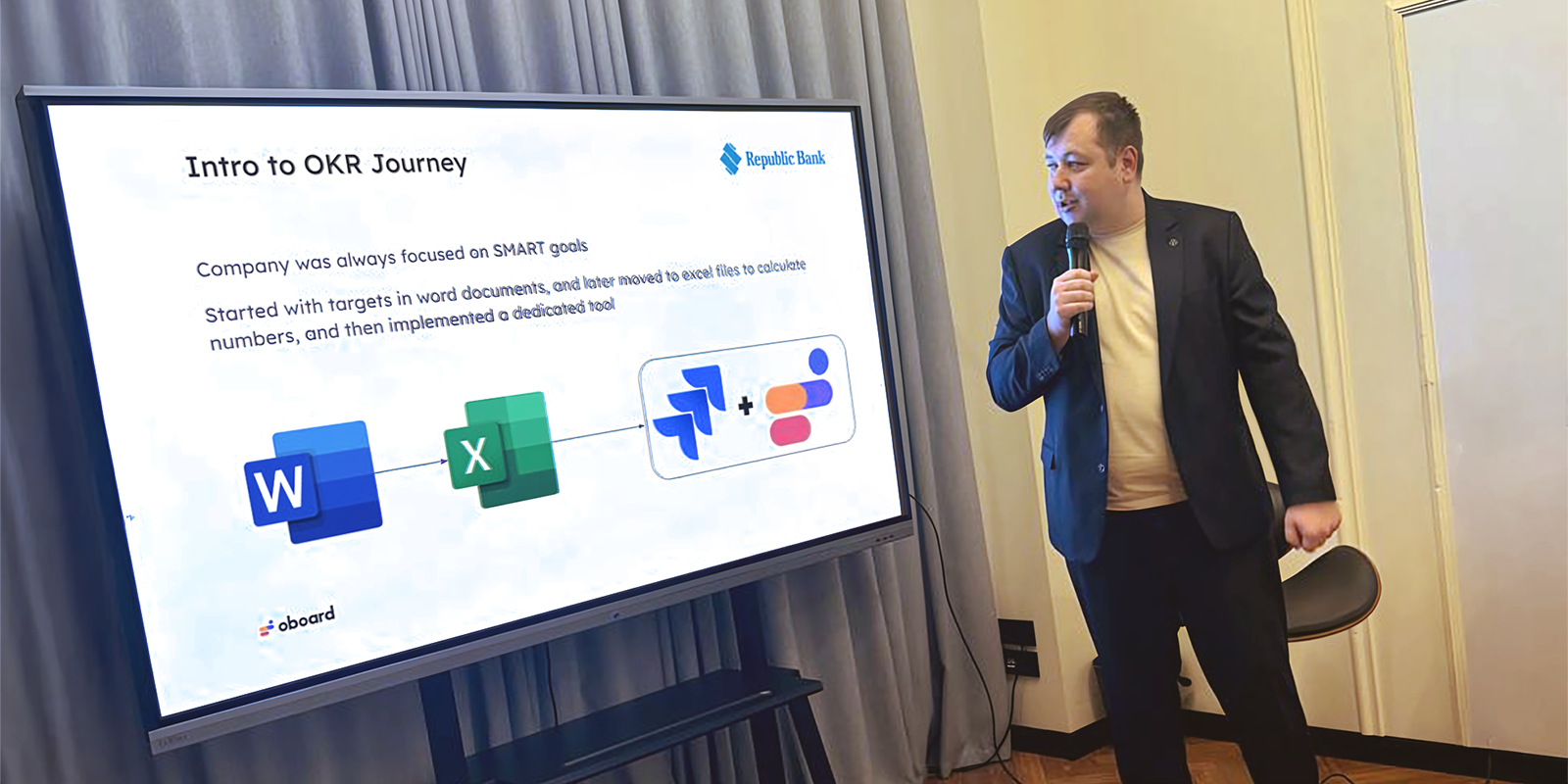
When Dmytro Lavrinenko was hired as Head of Engineering at Republic Bank, the company already had a strategy execution system to track progress toward major strategic objectives. That initial system required a lot of manual effort to maintain.
With the rapid company growth, the team was facing frequent change in priorities and new objectives. As a result, the team had alignment issues and lack of transparency. Many employees didn’t even realize they had alignment challenges, being overloaded with the day-to-day operations.
On the technical side, the situation was especially challenging — for example, in some teams the objectives were tracked via shared Word documents. With over 8,000 people and 125 branches involved in the OKR process, consolidation and organization of reports took a significant amount of time. As a result, any high-level report was substantially lagging, and visibility across the organization was poor.
To sum it all up, Dmytro ended up facing four key challenges:
Time-consuming consolidation of objectives from multiple sources;
Lack of transparency and accountability;
Difficulty in aligning strategic goals with execution;
Resistance from teams unfamiliar with OKR practices.
The only way to fix this situation was to become an OKR champion and evolve the company’s culture and strategy execution approach. This is precisely what Dmytro ended up doing, with help from Oboard as a key instrument.
“Before Oboard, we spent hundreds of hours manually collecting updates and building progress reports. Moreover, data quickly became outdated, and everyone felt confused. Now, we can see the whole picture, from strategic company goals to daily tasks in Jira in one place, with the progress updated automatically. It took enormous pressure from the Engineering team and helped them focus on impactful work.”
Dmytro Lavrinenko
Head of Engineering at Republic Bank
Why Did Republic Bank Choose Oboard
While the issues with the corporate culture were the most debilitating, they needed an iterative approach and time. The technical challenges could have been resolved quicker, which became the first step. Switching from Word documents to partially automated Excel spreadsheets allowed the company to keep up with the most critical processes. However, it wasn’t enough. The leadership team needed a way to keep track of everything happening on the tactical level while also clearly understanding how each of those tactical processes impacted their strategic objectives.
Jira was the obvious solution to the execution side of things — it is robust, customizable, relatively easy to learn, and allows to keep track of all the issues that the team is facing. However, Jira’s strategy planning tools are lacking, and its ability to bridge the gap between strategy and execution is non-existent. This is where Oboard came in.
Oboard’s OKR Board for Jira is developed specifically to connect Jira issues to strategic objectives, showing how daily work impacts the company’s goals in real time. This allows for a much greater degree of alignment, allowing the company to focus all of its efforts on the strategic goals. In addition to that, it also makes the working process much more transparent, enforcing the culture of accountability. Finally, Oboard OKR Software is highly scalable and easy to organize, easily reflecting any internal company structure and tracking even hundreds of thousands of employees.
How Republic Bank Transformed Their Strategy Execution With Oboard
Implementing the OKR Board for Jira allowed Republic Bank to streamline its strategy execution, enhance transparency, and reduce the inefficiencies of managing OKRs manually.
1. Automation & Transparency
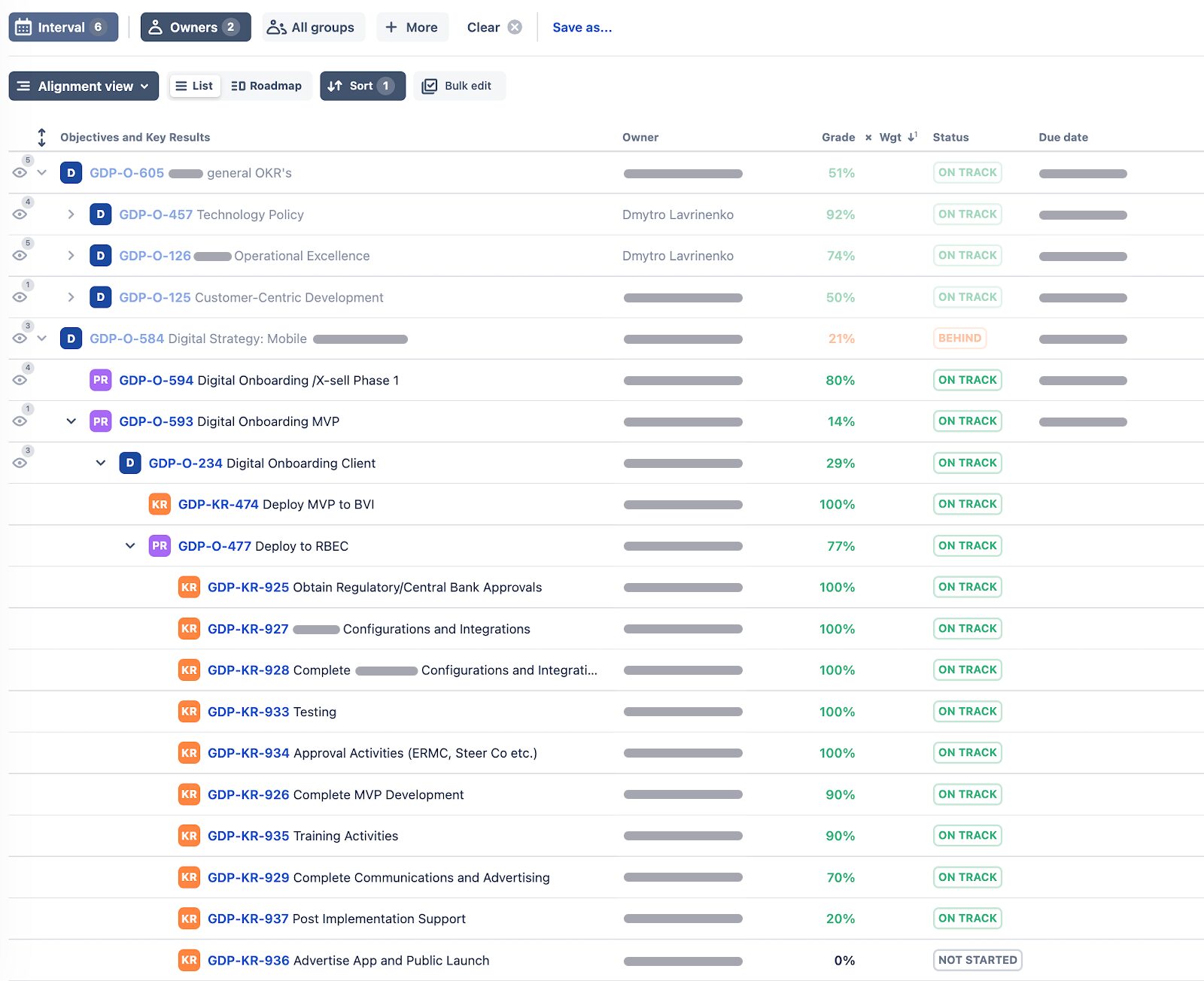
Before Oboard, consolidating OKRs across departments was a time-consuming manual process. With Oboard, Key Results now automatically pull data from Jira, reflecting real-time progress without requiring additional input from team leads. This shift significantly reduced administrative overhead and provided leadership with an up-to-date view of strategic execution at any time.
This view is further enhanced with customizable dashboards that can be built for any specific task in just a few clicks. For example, for a cross-department project, such a dashboard can contain only the relevant OKRs from both departments, making collaboration and alignment much more manageable.
Note: The examples below are adapted to the specifics of the Engineering department in a large-scale company with multiple divisions and mostly output-based OKRs.
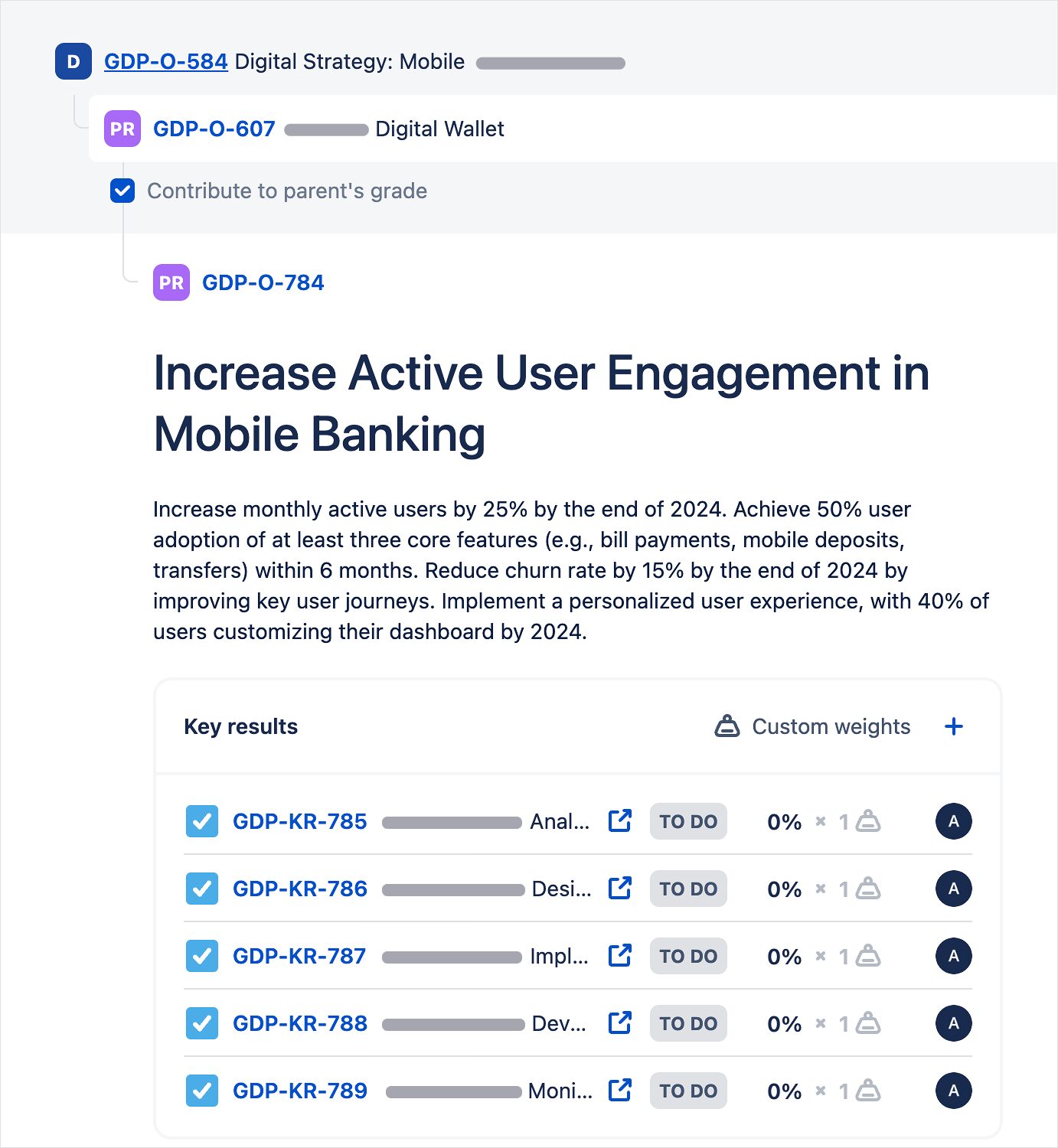
Example of an OKR set at Republic Bank
Finally, this transparency allowed for a much greater degree of understanding between Business and Engineering teams. With each engineering task linked to the strategic objective, the business team has a much better understanding of what the engineering team is doing and what resources they engage in it. In addition, the Business team can now easily cross-reference reports from all departments, which often help to determine the real causes of friction and provide better groundwork for future planning.
2. Scalable Budget-Driven Hierarchical OKRs
With substantial investments allocated to different strategic directions, Republic Bank needed to ensure that OKRs were aligned with financial priorities. Using Oboard’s custom fields to track the budget allowed the teams to prioritize objectives based on budget allocation, ensuring that resources were focused on the most impactful initiatives.
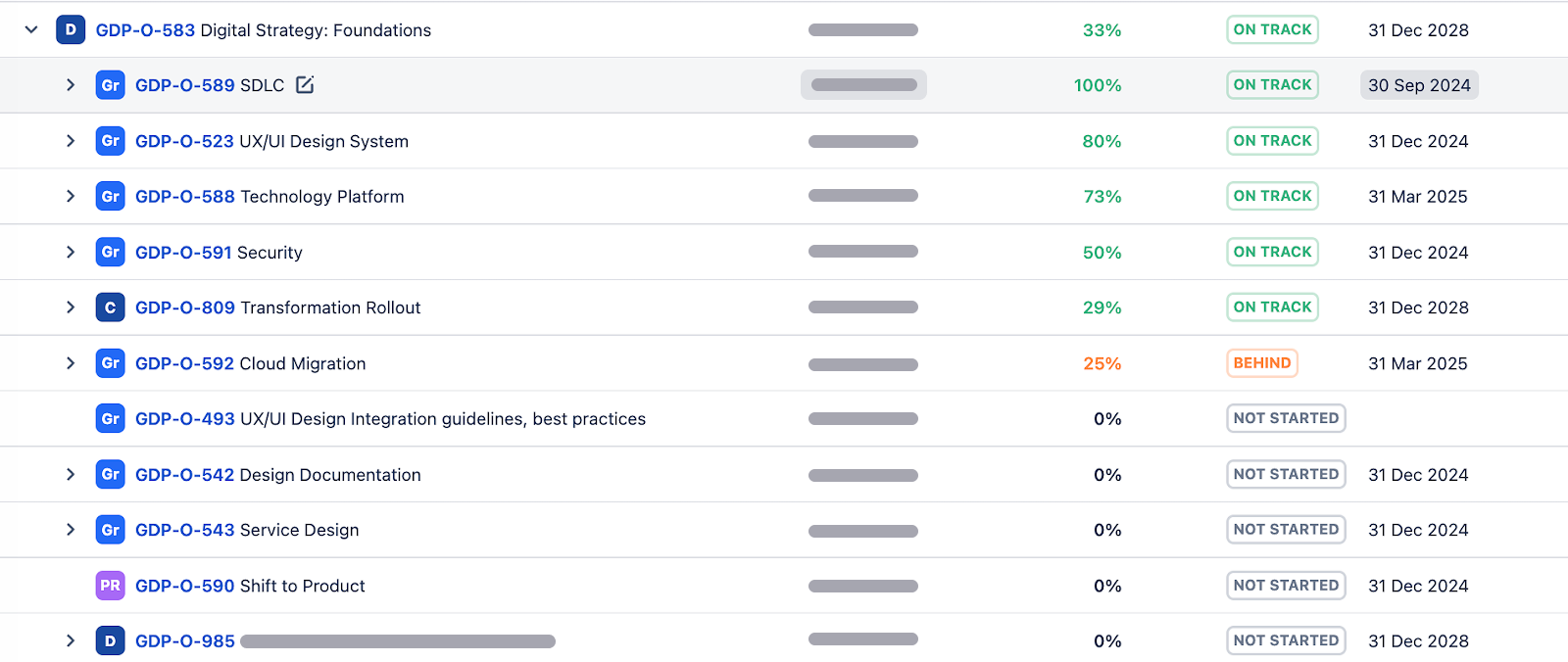
Example of Division Sub-OKRs: Group, Company, Project and Department Levels
In addition, Oboard enabled a multi-level OKR structure, setting objectives at various levels — Division, Group, Company, Product, Department, and Personal — while maintaining precise alignment. This ensured that both employees individually and every unit at every level were working toward the company’s strategic objective.
3. Clear Accountability & Ownership
One of the biggest issues with previous OKR tracking methods was the lack of clear responsibility. In Oboard, every Objective and Key Result has a designated owner, ensuring that each initiative has someone accountable for its progress. This structure eliminated ambiguity, making it easier to track performance and drive execution.
Example of OKRs for the Product department
4. Flexible OKR Management
Republic Bank operates across multiple regions and departments, each with its own requirements, and workflows. Oboard’s flexibility allowed teams to customize their approach. For example, while Engineering teams enjoyed automated OKR tracking, marketing and compliance found that task-based progress bar doesn’t represent their efforts well — and switched to manual tracking.
Example of top-level OKRs for the business department tracked manually
Another big hit was the ability to work in different OKR cadences — for example, each Department works on a quarterly cadence, while the company as a whole operates on both a yearly cadence for tactical decisions and a four-year cadence for strategic ones. This allows the teams to both make bold strategic plans and then break down each strategic objective into more manageable chunks when it comes to actual execution.
The Results
One year after implementing Oboard at Republic Bank, the new strategy execution system is at full steam. Here are the key achievements:
70+ team leads and 250+ employees actively manage OKRs in Oboard, ensuring strategic initiatives are tracked and executed effectively.
Seamless tracking of objectives across divisions, departments, and individuals, reducing the need for manual reporting.
Resistance to OKRs decreased as automation simplified processes, making it easier for teams to engage with strategy execution. Increased adoption as teams recognized efficiency gains, leading to broader buy-in across different functions.
Improved alignment between engineering and business teams, ensuring product development contributes directly to strategic goals.
Shift from activity-based to results-based thinking, focusing more on measurable impact than time spent.
Decision-making became data-driven, as real-time OKR progress provided leadership with better insights into company-wide initiatives.
OKRs are now can be easily prioritized based on budget allocation, ensuring financial resources are aligned with strategic goals.
Transparency across all levels of the organization improved, allowing teams to self-check progress without constant status meetings.
Overall, Oboard helped Republic Bank move from a manual, disconnected system to a fully integrated and automated OKR process. Leadership now has clear visibility into progress, employees have a structured yet flexible way to track execution, and the entire organization operates with a higher level of strategic clarity and accountability.
Learn how Oboard can connect your strategy to execution too!