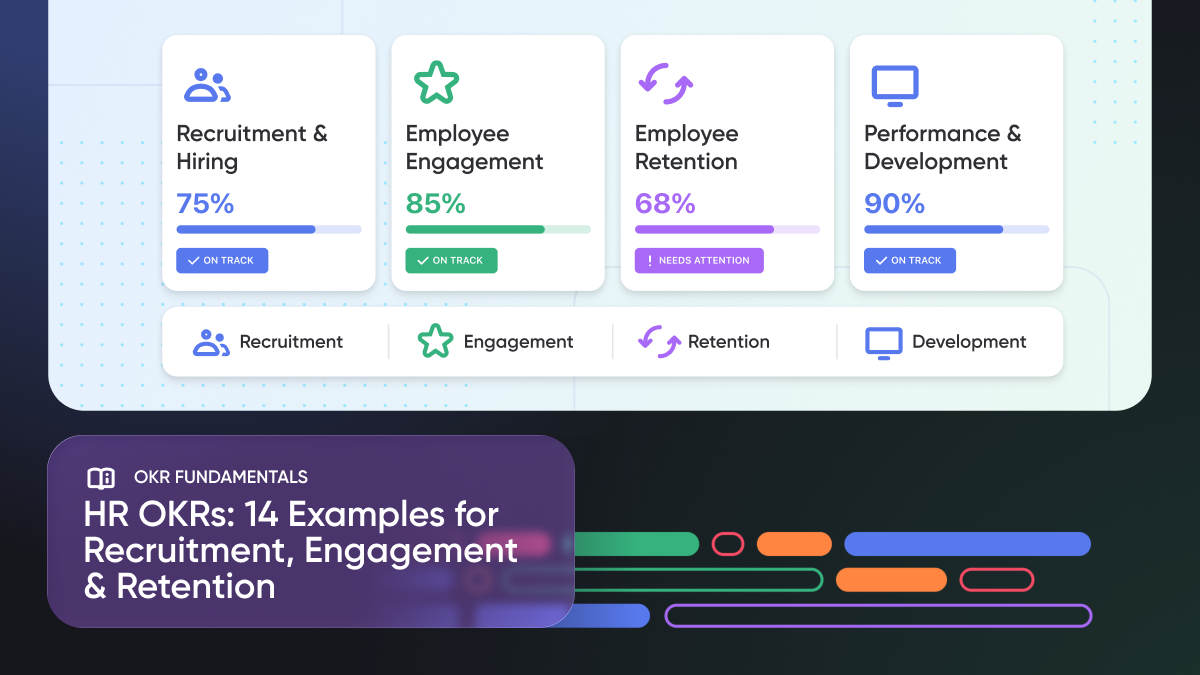
Human Resources teams are increasingly expected to demonstrate measurable business impact, not just complete administrative tasks. From recruiting top talent to retaining high performers, HR teams manage initiatives that directly influence business success. HR OKRs provide a structured way to define those priorities and measure progress toward them.
In this guide, we’ll explain the meaning of OKRs in HR, share 14 practical HR OKR examples across recruitment, engagement, retention, and employee development, and show you how to write HR OKRs that create real organizational impact.

TL;DR – Human Resources OKR Examples
What Are HR OKRs?
If you’re wondering what is OKR in HR, the concept is fairly simple. It’s just OKRs for HR folks. The OKR full form in HR is Objectives and Key Results, a goal-setting framework used to help HR teams focus on outcomes and measure progress toward them.
The OKR meaning in HR comes down to two components:
- Objectives: define what you want to achieve.
- Key Results: define how success will be measured.
For example, an HR team might set the objective: Improve employee onboarding.
The supporting key results could be:
- Reduce time-to-productivity from 90 to 60 days
- Increase onboarding satisfaction scores from 75% to 90%
- Achieve 100% completion of onboarding plans
Unlike traditional HR activities or to-do lists, HR OKRs focus on measurable improvements that contribute to broader business goals.
14 HR OKR Examples by HR Function
The best HR OKRs focus on measurable outcomes that support broader business goals. Below are practical OKR examples across four key Human Resources OKR categories and one category that ties directly to company goals.
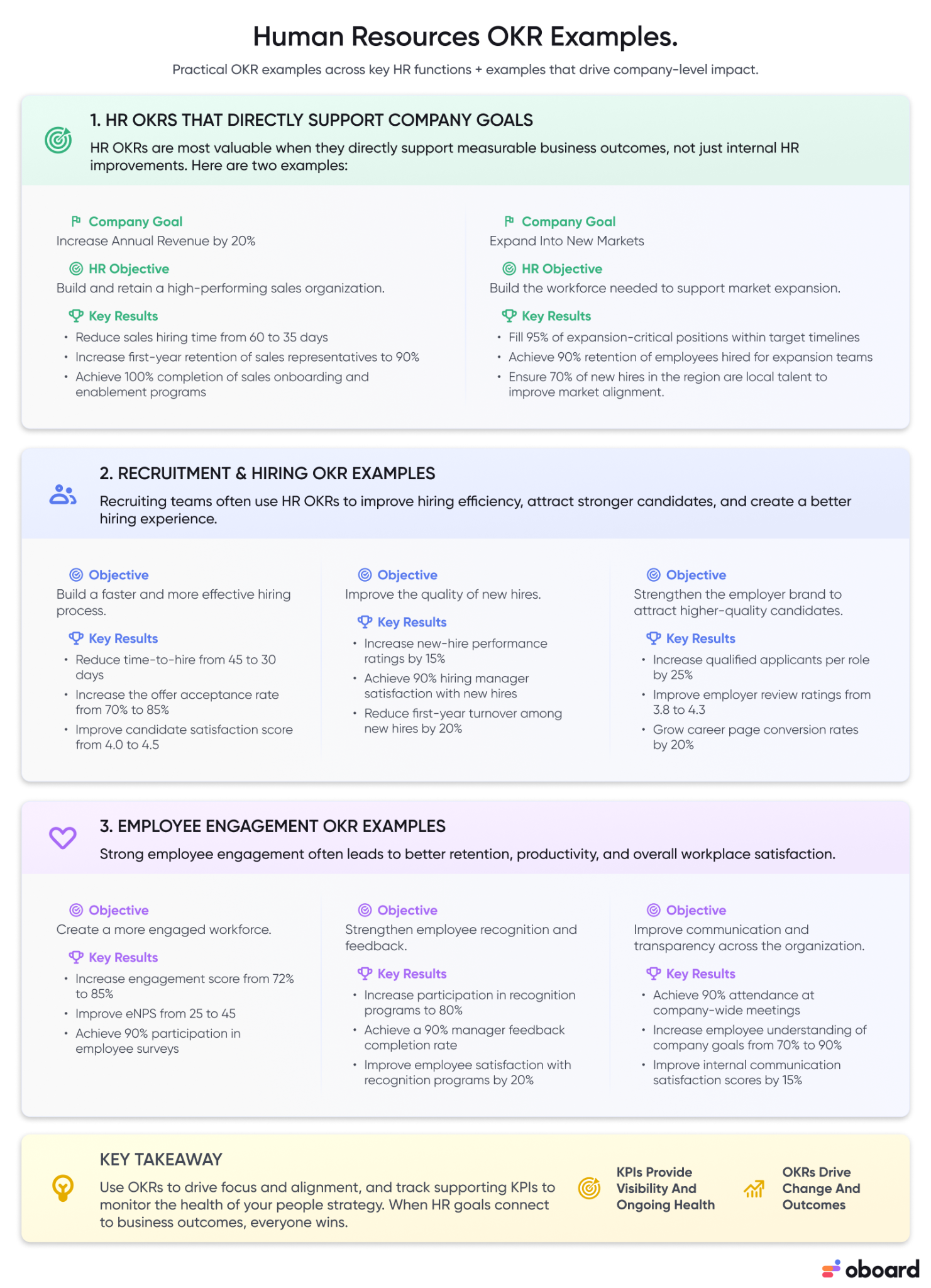
HR OKRs That Directly Support Company Goals
HR OKRs are most valuable when they directly support measurable business outcomes, not just internal HR improvements. Here are two examples:
Company Goal: Increase Annual Revenue by 20%
HR Objective: Build and retain a high-performing sales organization.
Key Results:
- Reduce sales hiring time from 60 to 35 days
- Increase first-year retention of sales representatives to 90%
- Achieve 100% completion of sales onboarding and enablement programs
Company Goal: Expand Into New Markets
HR Objective: Build the workforce needed to support market expansion.
Key Results:
- Fill 95% of expansion-critical positions within target timelines
- Achieve 90% retention of employees hired for expansion teams
- Ensure 70% of new hires in the region are local talent to improve market alignment.
Recruitment and Hiring OKR Examples
Recruiting teams often use HR OKRs to improve hiring efficiency, attract stronger candidates, and create a better hiring experience.
Objective: Build a faster and more effective hiring process.
Key Results:
- Reduce time-to-hire from 45 to 30 days
- Increase the offer acceptance rate from 70% to 85%
- Improve candidate satisfaction score from 4.0 to 4.5
Objective: Improve the quality of new hires.
Key Results:
- Increase new-hire performance ratings by 15%
- Achieve 90% hiring manager satisfaction with new hires
- Reduce first-year turnover among new hires by 20%
Objective: Strengthen the employer brand to attract higher-quality candidates.
Key Results:
- Increase qualified applicants per role by 25%
- Improve employer review ratings from 3.8 to 4.3
- Grow career page conversion rates by 20%
Employee Engagement OKR Examples
Strong employee engagement often leads to better retention, productivity, and overall workplace satisfaction.
Objective: Create a more engaged workforce.
Key Results:
- Increase engagement score from 72% to 85%
- Improve eNPS from 25 to 45
- Achieve 90% participation in employee surveys
Objective: Strengthen employee recognition and feedback.
Key Results:
- Increase participation in recognition programs to 80%
- Achieve a 90% manager feedback completion rate
- Improve employee satisfaction with recognition programs by 20%
Objective: Improve communication and transparency across the organization.
Key Results:
- Achieve 90% attendance at company-wide meetings
- Increase employee understanding of company goals from 70% to 90%
- Improve internal communication satisfaction scores by 15%
Employee Retention OKR Examples
Retention-focused HR OKRs help organizations keep top talent and reduce the costs associated with employee turnover.
Objective: Reduce voluntary turnover.
Key Results:
- Lower annual turnover from 15% to 10%
- Reduce first-year attrition by 20%
- Increase retention of top performers to 95%
Objective: Improve employee retention and career growth.
Key Results:
- Increase internal mobility by 15%
- Reduce regrettable attrition by 25%
- Improve employee career development satisfaction scores by 20%
Objective: Improve the onboarding experience for new employees.
Key Results:
- Increase onboarding satisfaction scores from 75% to 90%
- Reduce new-hire time-to-productivity from 90 to 60 days
- Achieve 100% completion of onboarding plans within the first month
Performance and Development OKR Examples
Many Human Resources OKR examples focus on helping employees grow while improving overall organizational performance.
⚠️ Important: While performance and development are common focus areas for HR OKRs, OKRs should generally not be used to evaluate individual employee performance or determine compensation. The purpose of OKRs is to drive alignment and organizational improvement. Tying OKRs directly to performance reviews can discourage ambitious goal-setting and encourage employees to focus on safe, easily achievable targets instead.
Objective: Improve employee growth and performance.
Key Results:
- Achieve 95% performance review completion
- Increase internal promotion rate by 15%
- Reach 80% participation in learning programs
Objective: Build stronger leadership capabilities.
Key Results:
- Increase leadership training completion to 90%
- Improve manager effectiveness scores by 15%
- Create succession plans for 100% of critical roles
Objective: Build a culture of continuous learning.
Key Results:
- Increase average training hours per employee by 25%
- Achieve 85% participation in professional development programs
- Improve employee confidence in career growth opportunities by 20%
If you’d like to see more OKR examples at a company level, check here.
💡Many organizations also track supporting KPIs alongside their OKRs. For example, an objective focused on improving employee retention may be supported by KPIs such as turnover rate, employee satisfaction, or internal mobility. While OKRs help drive change, KPIs help teams monitor the ongoing health of important HR functions.
How to Write Effective HR OKRs
Learning how to write HR OKRs starts with understanding that good OKRs focus on outcomes, not activities. The goal is not to create a list of HR tasks, but to define measurable improvements that support the business.
Start With an Outcome
A common mistake is turning routine activities into objectives.
- ❌Bad: Conduct an employee survey
- ✅Good: Increase employee engagement score from 72% to 85%
The objective should describe the result you want to achieve, while key results measure progress toward that outcome.
Make Every Key Result Measurable
Strong HR OKRs rely on clear metrics. Whenever possible, use percentages, scores, time-based measures, or retention metrics.
For example:
- Reduce time-to-hire from 45 to 30 days
- Increase employee retention from 85% to 92%
- Improve training participation rates from 60% to 80%
If success cannot be measured, it will be difficult to track progress.
Connect HR Goals to Business Impact
The most effective HR OKRs go beyond HR activities and contribute to broader organizational goals. Improvements in retention, hiring efficiency, employee productivity, and engagement all have a direct impact on business performance.
Common HR OKR Mistakes to Avoid
Even organizations with well-designed HR OKRs can struggle if they’re not implemented correctly. If you’re learning how to write HR OKRs, avoid these common mistakes.
1. Writing Tasks Instead of Outcomes
I know we’ve mentioned this earlier, but it’s worth repeating. One of the biggest mistakes is confusing activities with results.
Weak Key Result: Conduct employee surveys
Strong Key Result: Increase employee engagement score from 72% to 85%
The first measures effort, while the second measures impact.
2. Creating Too Many OKRs
Trying to track everything often results in teams focusing on nothing. Limit your OKRs to the highest-priority goals that will have the greatest impact.
3. Not Reviewing Progress Regularly
OKRs should not be created at the start of the quarter and forgotten. Regular check-ins help teams identify risks, remove blockers, and stay aligned.
4. Failing to Connect HR Goals to Business Outcomes
Metrics such as hiring speed, retention, engagement, and employee development should ultimately support broader organizational objectives. The strongest HR OKRs create a clear link between people initiatives and business performance.
How to Track HR OKRs in line with Organization Goals/Strategy
HR teams play a critical role in achieving company goals, but demonstrating that impact requires more than setting objectives; it requires consistent tracking. Many HR teams start with spreadsheets because they’re easy to set up. However, as the number of objectives grows, spreadsheets can become difficult to maintain. Manual updates, limited visibility, and fragmented reporting often make it harder to understand progress and identify risks early. This is especially important because OKRs are used to measure HR effectiveness across areas such as hiring, engagement, retention, and employee development. Without a reliable tracking process, it’s difficult to determine whether HR initiatives are delivering meaningful results aligned with the broader company strategy.
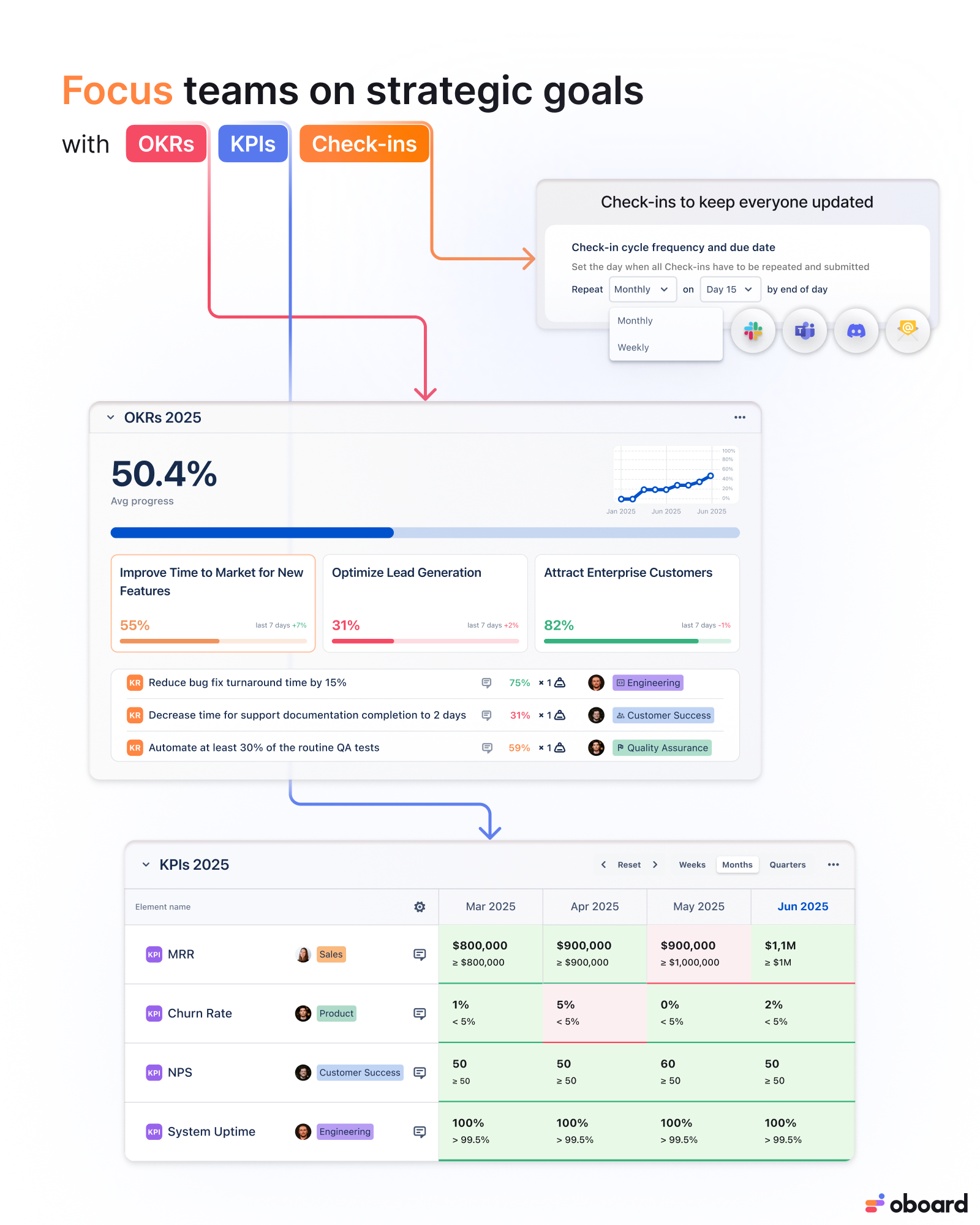
Oboard OKR Software helps bring those pieces together. Teams can connect HR OKRs to Jira initiatives, track supporting KPIs such as employee turnover, engagement scores, and time-to-hire alongside strategic goals, and see how everyday work contributes to business outcomes. For teams that don’t work in Jira, the Oboard OKR App offers a similar way to connect initiatives directly to objectives and automate progress updates.
Turn HR Goals Into Measurable Business Outcomes
The most effective HR teams ensure that they measure outcomes, and not merely a laundry list of tasks. Whether the goal is to hire faster, improve employee engagement, reduce turnover, or develop future leaders, HR OKRs provide a framework for turning those priorities into measurable results.

The examples in this guide can serve as a starting point, but the best OKRs are always tailored to your organization’s specific challenges and goals. Start with a few high-impact objectives, focus on outcomes rather than tasks, and review progress consistently throughout the quarter.