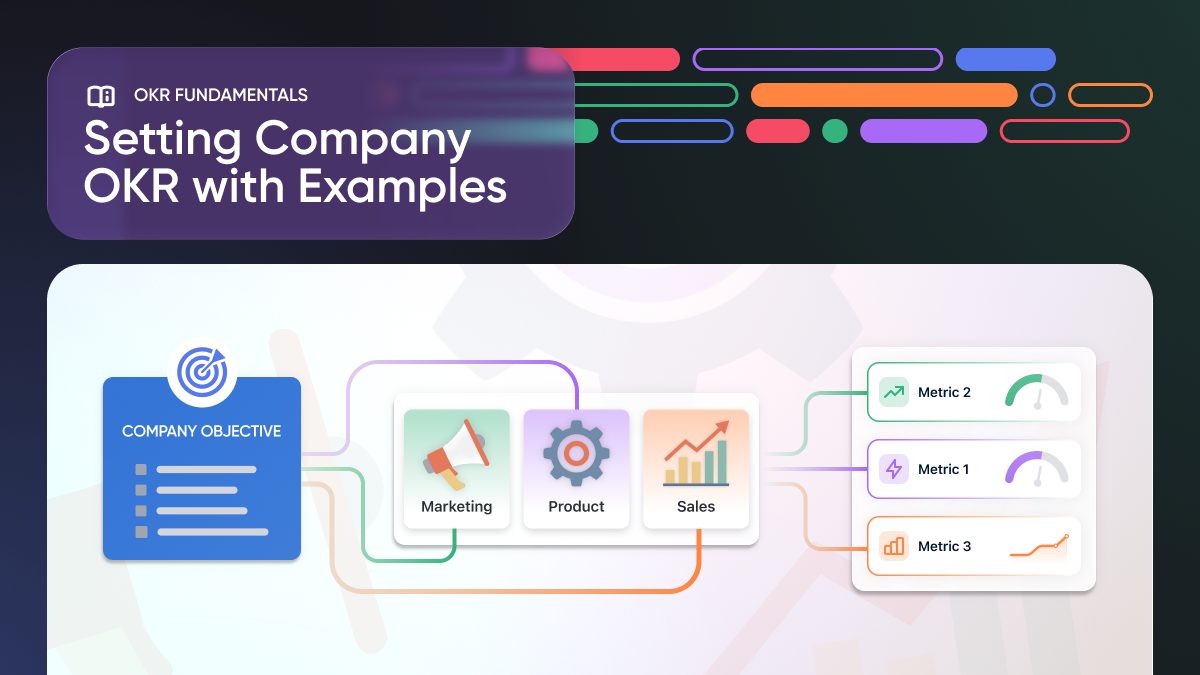
When teams set company OKRs, especially in an OKR-focused company, leadership usually starts with the right intention: translate strategy into something everyone can rally around. But things can quickly get abstract if not managed well. Take a look at these company OKR examples and try to spot the issue.
Company Objective example 1: Improve market leadership
Company Objective example 2: Enhance customer experience
They sound like goals, no argument there. But they leave one big question hanging – what is the rest of the company supposed to do with this? How does a team take “improve market leadership” and turn that into something measurable? Something they can decisively act on? Bad company-level OKRs start to lose people here. They look aligned, but don’t quite translate into day-to-day execution.
This article focuses on what helps: real company OKR examples, how to approach company-level OKRs properly, and what makes a business OKR work beyond the planning stage.

Company OKRs vs Team OKRs vs KPIs
A lot of the confusion around company OKRs comes from how loosely these terms get used. Company-level OKRs, Team/Department-level OKRs, and even KPIs can, in a sense, all be considered simply “goals.” It’s easy for anyone not well-grounded in OKRs to mash them all into one thing. At that point, it’ll be hard to tell what’s driving the business forward and what’s just being tracked out of habit.
So we’ll keep this simple.
- At the top, you have company-level OKRs. These are the few priorities the business is betting on for a given period. Not everything that’s important. If a company’s OKR doesn’t force you to focus or make a trade-off, it’s probably doing too much.
- Then you have team OKRs. This is where those company OKRs start to take shape across departments for them to work on. It’s the same structure, just closer to execution.
- And then there are KPIs. KPIs don’t try to change anything. All they do is tell you what’s going on. Revenue, retention, and conversion rates are always being tracked regardless of strategy. They give you a sense of how the business is performing, sometimes regardless of your company’s OKRs.
If you had to break it down quickly:
Company OKRs → what the business is trying to move
Department OKRs → how teams contribute to that
KPIs → how things are currently performing
Once you see the difference, writing a business OKR becomes more about choosing what matters at the moment.
Real-World Company OKR Examples (From Oboard Customers)
Before we get into how to write your own company OKRs, it helps to look at what formula has worked for other established businesses and real OKR examples you can take inspiration from.
Unlike benchmark examples, the following are drawn from real organizations actively using OKRs to manage strategy and execution. We’ve added links to each company example so you can read about their stories and successes in implementing OKRs.
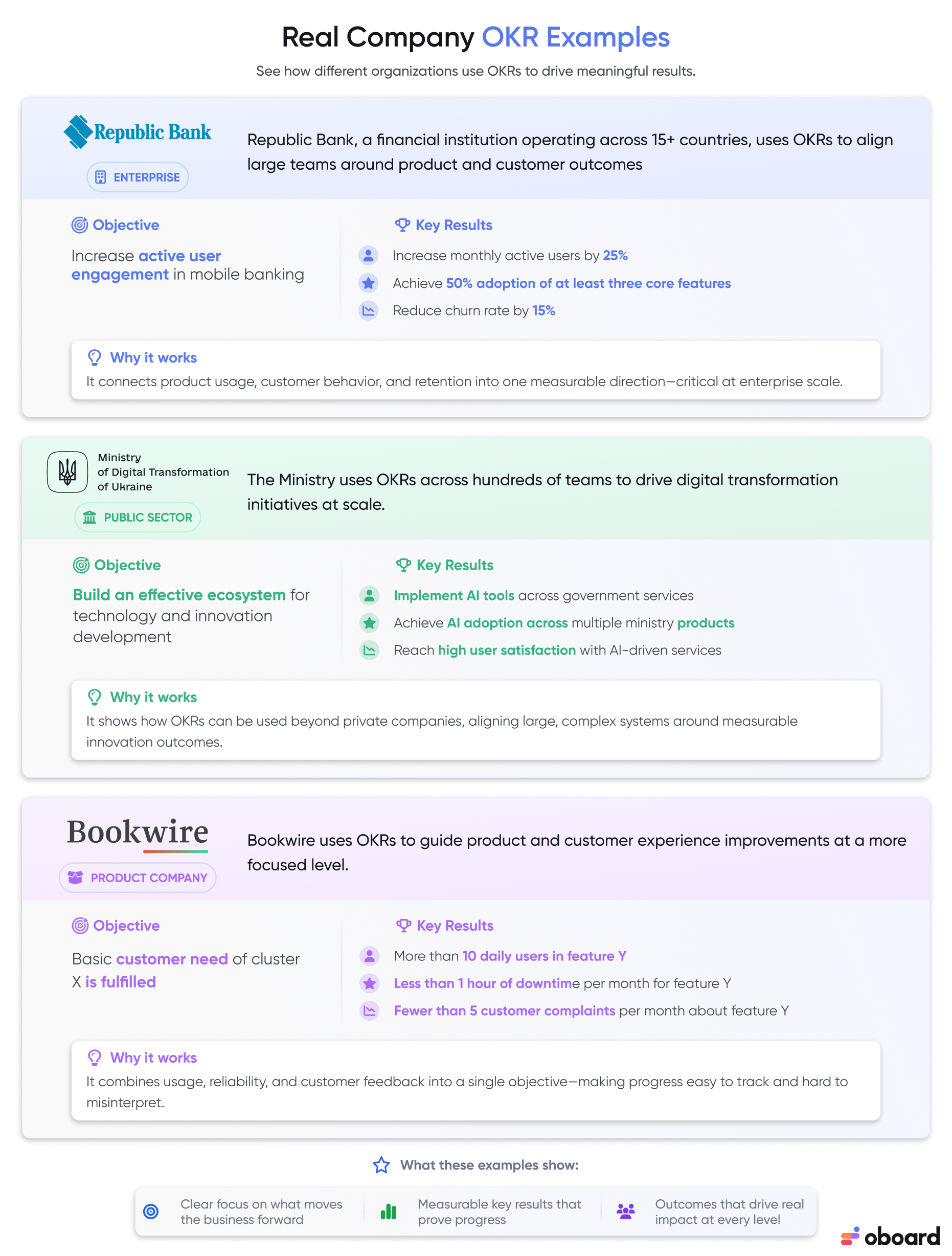
Public Sector OKR Example: Ministry of Digital Transformation of Ukraine
The Ministry uses OKRs across hundreds of teams to drive digital transformation initiatives at scale.
Objective: Build an effective ecosystem for technology and innovation development
Key Results:
- Implement AI tools across government services
- Achieve AI adoption across multiple ministry products
- Reach high user satisfaction with AI-driven services
Why it works: It shows how OKRs can be used beyond private companies to align large, complex systems around measurable innovation outcomes.
Enterprise Company OKR Example: Republic Bank
Republic Bank, a financial institution operating across 15+ countries, uses OKRs to align large teams around product and customer outcomes.
Objective: Increase active user engagement in mobile banking
Key Results:
- Increase monthly active users by 25%
- Achieve 50% adoption of at least three core features
- Reduce churn rate by 15%
Why it works: It connects product usage, customer behavior, and retention into one measurable direction, something especially important at an enterprise scale.
Product-Focused OKR Example: Bookwire
Bookwire uses OKRs to guide product and customer experience improvements with greater focus.
Objective: Basic customer need of cluster X is fulfilled
Key Results:
- More than 10 daily users in feature Y
- Less than 1 hour of downtime per month for feature Y
- Fewer than 5 customer complaints per month about feature Y
Why it works: It combines usage, reliability, and customer feedback into a single objective, making progress easy to track and hard to misinterpret.
If you want to see more of how real teams are implementing OKRs and making them work using Oboard, visit our customer stories page.
Company OKR Examples Inspired by Google and Intel
There’s one important thing to keep in mind before looking at more examples: most companies using OKRs do not publish their full current OKRs publicly. What you usually get instead are widely documented patterns, case references, and a few classic examples. Google’s re:Work guide, for instance, explains that Google often starts with organizational OKRs and aligns priorities around three to five objectives, each with about three key results. Intel is widely credited with creating the OKR system in the first place, so we can also consider them an authority here.
Google-style company OKR example
Objective: Improve the speed and quality of product delivery
Key Results:
- Reduce average release cycle time from 6 weeks to 4 weeks
- Increase on-time delivery rate for planned releases from 72% to 90%
- Cut critical post-release incidents by 30%
Why it works: It is focused, measurable, and hard to hide behind. That fits the broader Google approach to OKRs: a small number of priorities with clear ways to measure progress.
Intel-style company OKR example
Objective: Regain momentum in a critical product category
Key Results:
- Increase market share in the target segment by 8%
- Launch the new product line in 3 priority markets by the end of the quarter
- Secure 5 new strategic enterprise accounts
Why it works: This kind of example reflects how Intel’s OKR history is usually discussed: as a way to rally the company around a clear business outcome when focus really matters. Public references to Intel’s “Operation Crush” story by John Doerr make that pretty clear.
How to Write Company OKRs That Are Clear and Measurable
You don’t need a complicated framework to design effective company OKRs. If anything, the more complex it gets, the less useful it becomes. A good company OKR should feel obvious once you read it, clear enough that different teams can look at it and immediately understand what matters.
- Start with the objective. At the company level, the objective should be strategic. Not a task, not a project, not a department goal, but something that reflects where the business is headed.
- Then come the key results. Company OKRs can easily go off track here. A key result is not something you do. It’s something you achieve. There should be a clear way to measure it without debate. If two people can look at the same business OKR and disagree on whether it’s complete, the key result probably needs work.
A quick way to sense-check it:
- Launch new campaign → task
- Increase qualified leads from campaign by 25% → key result
- The last piece is focus. You don’t need ten company-level OKRs. In fact, that usually defeats the point. As Google’s OKR philosophy suggests, most teams work better with a small set of priorities they can remember and act on. The moment everything becomes a priority, nothing really is.
One thing that becomes obvious once you start doing this: writing company OKRs is only half the job. The other half is to keep them visible and up to date across the business. If people can’t see progress — or don’t revisit it regularly — even well-written company OKRs will eventually fade. The point is: OKR tracking is very important. We’ll get to that in more detail shortly.
Bonus Company OKR Examples by Department and Business Focus
Here are some more company OKR examples you can learn from or even adapt. These aren’t pulled from any one company’s internal plan. Think of them as realistic company-level OKR examples based on how businesses typically structure priorities across different focus areas.
Company OKR examples for growth
Objective: Accelerate revenue growth in our core market
Key Results:
- Increase monthly recurring revenue (MRR) by 20%
- Improve sales conversion rate from 18% to 25%
- Generate 30% more qualified inbound leads
- Expand into 2 new high-potential market segments
Why it works: It’s clear what “growth” means here. Not just more activity, but measurable business impact across revenue, conversion, and expansion.
Company OKR examples for product and innovation
Objective: Deliver a product experience that drives long-term adoption
Key Results:
- Increase [specific] feature adoption rate from 45% to 65%
- Reduce average time-to-value for new users from 14 to 7 days
- Improve product satisfaction score (CSAT) from 7.8 to 8.5
Why it works: This business OKR connects product work directly to user outcomes. They’ve moved from just shipping the feature to whether those features are used and valued.
Company OKR examples for operations
Objective: Improve operational efficiency across key processes
Key Results:
- Reduce average project delivery time by 25%
- Decrease operational costs by 15% without affecting output
- Improve on-time project delivery rate from 70% to 90%
- Automate 3 high-impact internal workflows
Why it works: It focuses on efficiency in a way that’s measurable and hard to fake. Each key result ties directly to time, cost, or consistency.
Company OKR examples for customer experience
Objective: Build a customer experience that drives retention and loyalty
Key Results:
- Increase customer retention rate from 78% to 88%
- Improve Net Promoter Score (NPS) from 32 to 50
- Reduce average support response time from 6 hours to 2 hours
- Decrease churn rate by 20%
Why it works: It ties customer experience to real business outcomes like retention and churn, not just “improving satisfaction” in a vague sense.
Company OKR examples for people and culture
Objective: Build a high-performing and engaged team
Key Results:
- Increase employee engagement score from 70% to 82%
- Reduce voluntary employee turnover from 18% to 10%
- Achieve a 90% completion rate for internal development programs
- Improve internal mobility rate by 15%
Why it works: This company-level OKR focuses on measurable signals of team health, not just broad ideas like “improve culture.”
Across all of these company OKR examples, the pattern stays the same:
- The objective sets direction
- The key results make it measurable
- The scope stays focused
OKR Key Results Examples: What Good Key Results Look Like
Objectives get all the attention, but key results are where the real work is. And the difference between a good one and a weak one is pretty easy to spot once you know what to look for.
Let’s put them side by side for better contrast.
Weak vs Strong Key Results
Example 1 (Marketing)
❌ Launch new campaign
✅ Increase qualified leads from campaign by 25%
Example 2 (Product)
❌ Release new onboarding flow
✅ Improve user activation rate from 40% to 60%
Example 3 (Customer Success)
❌ Improve customer support
✅ Reduce average response time from 6 hours to 2 hours
Weak key results focus on tasks. Strong ones focus on outcomes. That difference becomes critical at the company level because measurable key results make progress easy to track, easy to understand, and much harder to misinterpret. And once OKRs are live, consistent visibility matters just as much as writing them well, which is why many teams rely on centralized tools like Oboard OKR Software to keep updates and execution aligned.
Business OKR Examples for Different Company Priorities
Not every company is trying to solve the same problem at the same time. Some are chasing growth. Others are trying to fix profitability. Some are expanding into new markets, while others are just trying to keep the customers they already have. That’s why a good business OKR always reflects what matters in the moment.
Here are a few business OKR examples based on different company priorities:
Growth-focused business OKR
Objective: Grow revenue from core products
Key Results:
- Increase monthly recurring revenue by 25%
- Improve lead-to-customer conversion rate from 20% to 30%
- Generate 40% more inbound leads through organic channels
Profitability-focused business OKR
Objective: Improve overall business profitability
Key Results:
- Increase gross margin from 55% to 65%
- Reduce customer acquisition cost (CAC) by 20%
- Decrease operational expenses by 15%
Why it works: This is a classic business OKR that ties financial health directly to measurable levers.
Expansion-focused business OKR
Objective: Successfully expand into new markets
Key Results:
- Enter 2 new geographic markets by the end of the quarter
- Acquire 100 new customers in each new market
- Establish 3 strategic partnerships in target regions
Why it works: It turns a broad goal like “expansion” into something concrete and trackable.
Retention-focused business OKR
Objective: Improve customer retention and lifetime value
Key Results:
- Increase customer retention rate from 75% to 85%
- Reduce churn rate by 20%
- Increase average customer lifetime value (LTV) by 15%
Why it works: It focuses on keeping existing customers, which often has a bigger impact than chasing new ones.
Innovation-focused business OKR
Objective: Drive product innovation and long-term differentiation
Key Results:
- Launch 2 new high-impact product features
- Increase adoption of new features to 50% of active users
- Generate 20% of new revenue from recently launched features
Why it works: It connects innovation to real outcomes — usage and revenue — not only activity.
Common Mistakes Companies Make with Company-Level OKRs
The failure of most company-level OKRs is not as dramatic as one might expect. It’s usually a slow drift. The ones that are dramatic would usually be obvious very early. Either way, here are the usual culprits of failed company OKRs:
- Too many company OKRs: This one shows up early. Instead of having a few clear priorities, the company ends up with a long list of “important” objectives.
- Task-based Key results: We touched on this earlier, but it’s worth repeating, as it happens often. When key results turn into task lists, teams stay busy, but it’s hard to tell if anything meaningful is improving.
- Confusing KPIs with OKRs: KPIs track what’s already happening. Company OKRs are meant to drive change. When the two get mixed up (and they likely will if you have no idea what you’re doing with OKRs), you end up with goals that don’t really change direction; you just report on them.
- No clear ownership or visibility: This one doesn’t get talked about enough because it’s so easy to miss. If no one clearly owns a company OKR, or if teams can’t easily see how progress is going, alignment will break down. People go back to their own (often irrelevant to strategy) priorities because the bigger picture isn’t visible.
- OKRs not reviewed consistently: Even well-written company OKRs won’t survive without regular check-ins. If updates only happen at the end of the quarter, it’s already too late to adjust anything. The whole point is to track progress while there’s still time to respond. A good practice here is to use 1:1s as quick KR retrospectives.
What ties all of this together
Most of these issues stem from a lack of structure in how the company tracks and reviews OKRs. When OKRs are scattered across docs, slides, and spreadsheets, it becomes difficult to see what’s moving and what’s stuck. Strong company-level OKRs should be supported by a clear way to track, review, and keep them visible across the business.
How to Track Company OKRs Across Teams
You can write solid company OKRs and still lose them halfway through the quarter. As we said, it’s not necessarily because you wrote bad goals; you just didn’t account for the best way to track them. At that point, company-level OKRs stop doing their job; they’re still where you kept them after planning, but they’re not part of a living, breathing strategy that can be executed day-to-day.
- Keep company OKRs in one place
- Make it obvious who owns what
- Update progress regularly (not just at the end)
- Make it easy to tell what’s moving and what isn’t
That’s really it. And the best way to do this is to use a living goal management system. Oboard OKR and KPI software was built to be the direct solution to this issue.
The OKR Software Advantage
- One place for all company OKRs: No spreadsheets, slides, or scattered docs. Everything lives in a single workspace, so you’re not piecing together updates.
- Clear alignment from company to teams: You can see how team OKRs connect to company-level OKRs without needing a separate alignment exercise.
- Structured check-ins with editable templates: Progress updates happen in a consistent format, so you’re not chasing people or decoding vague status reports.
- Real-time dashboards: You don’t need to ask where things stand. You can see what’s on track, at risk, or stuck at a glance.
- Ownership built into the system: Every company OKR and key result has a clear owner, so nothing falls into that “someone should handle this” gap.
- Works with tools teams already use: This is a big one. Instead of OKRs sitting in a separate tool, they’re connected to actual work like in Jira, Confluence, monday.com, and Salesforce, so task updates reflect real progress.
You’ve Set Company OKRs, Here’s How To Achieve Them
We’ve seen what good company OKRs look like, how to write them, and where they usually go wrong. None of it is complicated — but it does fall apart quickly if those OKRs aren’t tracked and used consistently across teams. Most of the issues we covered arise when company OKRs are no longer visible. And that can make all the difference. Writing a solid business OKR gets you started; keeping it visible and up to date is what makes it work long-term.
If you’ve gotten the setting-OKRs part nailed, it’s important to consider the final leg of execution and tracking. Book a short demo call today for a live practice session to see what better goal tracking looks like. Want to jump right in to see how Oboard works for yourself? Get started here.