Give your agents a purpose with a strategic context layer
Focus AI on what your company is trying to achieve — strategy, OKRs, KPIs and initiatives — so answers come back specific to your business, and your teams spend less time correcting them
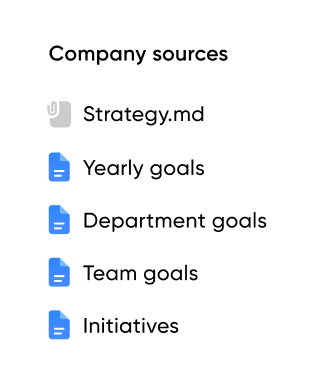
Alignment across humans and agents
Aligns agents with company purpose
Agents act according to business goals, priorities and constraints — not whatever is visible in the task.
Produces context-specific answers
LLM responses become more relevant, more precise and grounded in the company’s reality.
Saves tokens and time
Less repeated prompting, fewer clarification loops and fewer corrections to undo.
Strategy context enables
32% stronger answers on 29% fewer tokens


Answer quality
Mean answer quality (7.50 vs 5.67 out of 8, shown as %) for prompts with structured context — goals, rules, format — vs raw prompts, across ChatGPT, Claude and Grok (Ghosh, 2026, arXiv 2605.20149). Consistent with ROPE (arXiv 2409.08775: requirement quality ↔ output quality, ρ = 0.71) and Anthropic’s guidance to explain goals for more targeted answers.
Tokens per answer
Mean input + output tokens per accepted answer in the same study (683 vs 962). Both reached an accepted answer in one turn; asking clarifying questions instead of giving context nearly doubled the turns (1.96).
Context size
200K is the smallest window among today’s leading LLMs; the median across 20 leading models is 1M, where Oboard context is ~0.1% (Morph LLM, 2026). Short, focused context outperforms long, noisy context (Chroma “Context Rot”, 2025; Anthropic, “Effective context engineering”, 2025).
Connect strategy to execution — for people and AI
Connect strategy
Turn priorities into connected company, department and team goals.
Connect work
Tie initiatives and delivery activity directly to strategic outcomes.
Connect metrics
Keep KPIs and Key Results updated from the systems where work happens.
Connect people
Run structured check-ins without creating another reporting workflow.
The same prompt can produce a completely different decision
We received 47 feature requests from customers this quarter. Rank the top 5 for next sprint and justify.
Build SCIM provisioning and audit logs first.
SCIM provisioning and audit logs move to the top because they directly unblock enterprise security reviews — the documented bottleneck affecting 4 of 6 active enterprise trials and putting KR1 and KR3 at risk.
Build bulk CSV export first.
Bulk CSV export ranks #1. It has 22 customer votes, is requested across many accounts, and is estimated at only two days of engineering work. It offers the strongest combination of demand and speed.
Review the open pipeline and tell the sales team which account should get executive attention this week.
Escalate NordBank.
NordBank should get executive attention even though its current close probability is only 40%. It is a €120k regulated-enterprise opportunity in a priority vertical and would count directly toward the lighthouse-customer objective.
Escalate Acme Digital.
Acme Digital should get executive attention. It is a €42k opportunity with a 75% close probability, a responsive buyer, and a decision expected this month. Executive involvement could help close it quickly.
We have €50k left in this quarter’s marketing budget. Recommend how to allocate it across channels and justify.
Put the budget into German enterprise demand.
Allocate the €50k to German enterprise programs: targeted events, local-language executive content, account-based campaigns and partner activation. These channels are less efficient on raw CPL, but directly address the at-risk Germany pipeline and awareness KRs.
Put most of the budget into paid search.
Allocate €35k to paid search, the current best-performing channel at €84 CPL, and €15k to retargeting. This should maximize lead volume while keeping acquisition cost low.
Bring Oboard wherever AI works


